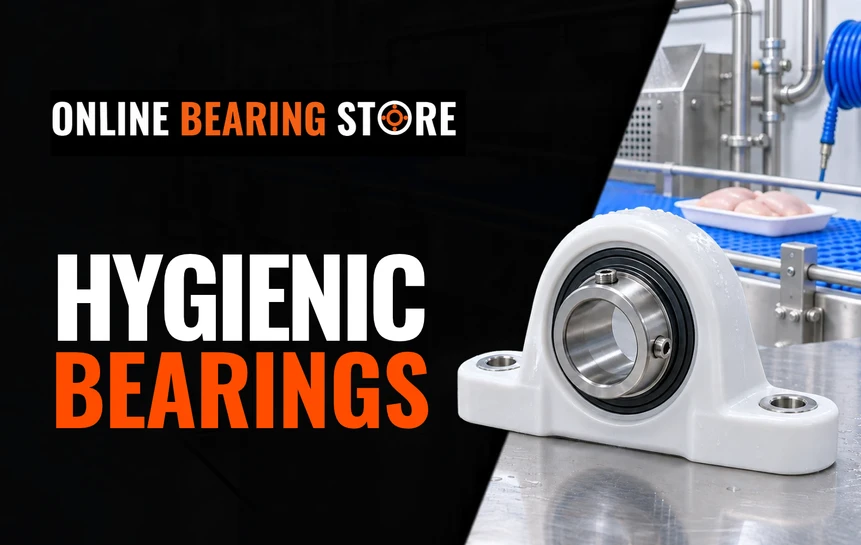
Conveyor Bearings in Meat and Poultry Processing: What Makes This Environment Different
A poultry evisceration line stops dead mid-shift because a take-up bearing on the main transfer belt finally seized up after weeks of nightly washdowns stripped out its grease, costing hours of lost throughput, held product and sanitation overtime. Meat and poultry processing plants punish equipment in ways few other industries match, combining daily high-pressure sanitation, aggressive chemicals, heavy organic soils, and extreme temperature swings all within the same shift. In this guide, you will learn what makes conveyor bearings for meat and poultry processing uniquely exposed to failure, how each plant stressor breaks down standard parts, and which bearing designs actually survive the job.
Why Is Meat and Poultry Processing So Hard on Conveyor Bearings?
Meat and poultry plants destroy standard bearings because daily food safety rules require intense wet cleaning right next to raw protein. Unlike dry factories or packaged-goods lines, your conveyors run directly through splashes of blood, fat, and harsh chemicals, facing full high- pressure washdowns every single day.
Sanitation Is Built into Every Production Day
In most manufacturing plants, a bearing sees a splash of water maybe a few times a year. On your floor, full washdowns happen after every shift or production run, alongside quick rinses during shift breaks. Your meat processing conveyor bearings and poultry processing bearings endure more water and chemical exposure in a single week than general-purpose bearings see in an entire year.
Raw Protein Raises the Hygiene Bar
Raw poultry and red meat carry serious pathogen risks, especially Listeria and Salmonella. Because there is zero room for error on food safety, your sanitation crew cannot just wipe down belts with a damp rag. They must foam, scrub, and sanitize every surface down to bare metal to pass pre-op swabs, pushing moisture and chemicals straight toward your rotating shafts.
Bearings Sit Directly in the Splash Zone
On your lines, food processing conveyor bearings rarely sit tucked safely away inside dry electrical cabinets. They sit right beside or underneath open product. As birds or meat cuts travel down the line, bearings catch direct drips of brine, marinade, blood, and rinse water. Even double-shielded units take a constant bath that eats away standard steel and grease, driving early bearing failure in food processing.
|
Plant Stressor |
Where It Occurs on the Line |
What It Does to the Bearing |
Design Feature That Resists It |
|
High-Pressure Spray |
All wet zones (evisceration, cut-up, deboning) |
Forces water past standard seals and washes out grease |
Multi-lip contact seals, flingers, and closed end caps |
|
Chlorinated & Caustic Chemicals |
Whole plant during nightly foaming and sanitizing |
Pits chrome steel, flakes paint, and swells rubber seals |
300-series stainless steel or thermoplastic housings |
|
Fat, Blood & Protein Soils |
Kill floor, evisceration, trim, and grinding lines |
Packs around seals, traps bacteria, and dilutes grease |
Smooth, flush housings with zero recesses or blind holes |
|
Extreme Heat & Cold Swings |
Scalders, cookers, chillers, and spiral freezers |
Stiffens grease, cracks seals, and pulls in moisture |
Solid lubricant polymers or wide-temp synthetic grease |
How Does High-Pressure Washdown Damage Conveyor Bearings?
High-pressure washdowns ruin bearings by blasting water past standard seals, washing out internal grease, and causing rapid temperature drops that suck dirty water inside. Even if a bearing survives the chemical foam, the sheer force and heat of the final rinse water can strip away its internal protection in minutes.
Water Forced Past Standard Seals
Sanitation wands can run at 1,000 psi or higher. Standard non-contact metal shields and single-lip rubber seals simply cannot hold back a direct blast at that pressure. Water slices right past the seal lip and floods the bearing raceway, which is why you need purpose-built washdown conveyor bearings engineered with multi-stage sealing.
Grease Washout and Emulsification
Once water gets inside the cavity, it mixes with standard petroleum grease and whips it into a thin, milky paste. As your shaft spins, that watered-down grease leaks right out of the housing. Without a thick oil film separating the moving parts, steel balls grind directly against steel raceways, triggering fast wear, deep rust, and sudden bearing failure in food processing.
Thermal Shock and the "Breathing" Effect
Washdown water is often heated to 120°F to 140°F to melt stubborn animal fats. When that hot water hits a cold bearing, the air trapped inside the housing expands. Minutes later, when cold room air hits the unit, the air inside shrinks fast. This sudden pressure drop creates a vacuum, often called the "breathing" effect, that pulls dirty rinse water straight past the seals. Specifying bearings for high-pressure washdown with a strong washdown rating (a measure of how well an enclosure blocks high-pressure, high-temperature water jets, such as an IP69K-tested design) helps resist this vacuum pull with tight contact lips and solid cavity fills.
What Do Sanitation Chemicals Do to Bearing Materials?
Aggressive sanitation chemicals eat away at standard bearing metals and rubber seals. Chlorinated cleaners and high-pH caustics rust carbon steel and strip paint, while acid sanitizers pit lower-grade stainless steel and cause standard rubber seals to crack, swell, or turn brittle.
Chlorinated and Caustic Cleaners
To cut through heavy grease and protein films, sanitation crews rely on strong alkaline foams and chlorine-based cleaners. Understanding how sanitation chemicals and bearings interact is critical here. If you run standard chrome steel inserts inside painted cast-iron housings, these chemicals will ruin them fast. Paint blisters and flakes off, creating a serious foreign-material hazard over open food, while the bare iron rusts overnight.
Acid Sanitizers and Peracetic Acid
Many plants rotate in acid rinses or run peracetic acid (PAA) to knock down bacteria and prevent mineral scale. PAA is notoriously rough on hardware. It causes tiny pinpoint rust pits on 400- series stainless steel and breaks down standard nitrile (Buna-N) rubber seals, opening up gaps where water sneaks inside.
Which Materials Hold Up
Picking the right base metal stops chemical decay before it starts. Comparing corrosion- resistant bearings and stainless steel conveyor bearings helps you match the housing and insert to your plant's exact wash chemistry.
|
Material Option |
Corrosion Resistance |
Load Capacity |
Temperature Range |
Relative Cost |
|
Chrome Steel (52100) |
Poor (rusts fast in wet areas) |
Very High |
-40°F to 250°F |
Low ($) |
|
400-Series Stainless (440C) |
Moderate (can pit in chlorides/acids) |
High |
-40°F to 300°F |
Moderate ($$) |
|
300-Series Stainless (304 / 316) |
Excellent (resists caustics & acids) |
Moderate |
-100°F to 400°F+ |
High ($$$) |
|
Thermoplastic Housing (PBT) |
Excellent (impervious to chemicals) |
Moderate |
-30°F to 220°F |
Moderate ($$) |
Note: Most washdown mounted units pair a 300-series or 440C stainless steel insert with thermoplastic bearing housings or 316 stainless steel housings for the best mix of strength and chemical defense.
How Do Fat, Blood, and Protein Residue Affect Bearing Life?
Animal fat, blood, and protein scraps shorten bearing life by packing around seals, trapping bacteria, and breaking down internal grease. Unlike dry dust in a warehouse, organic soils stick tightly to metal and act like grinding paste once they work past a worn seal lip.
Organic Soils as Contaminants
On kill floors, evisceration lines, and trim tables, raw soils coat everything. Feathers, bone dust, blood, and fat cake up around the rotating shaft right where it meets the rubber seal. As that buildup dries and hardens between runs, it acts like sandpaper, chewing away the seal lip until water and grit pour inside your meat processing conveyor bearings.
Harborage Points on Housings
Standard industrial pillow blocks have recessed pockets on the back, open cavities around grease fittings, and exposed set screws. On your line, those crevices trap raw meat scraps and moisture.
Bacteria thrive inside those hidden pockets, leading to failed pre-op swabs and chronic rust from the inside out, a primary driver of bearing failure in food processing.
Animal Fat Mixing with Lubricant
Warm animal fats and cooking oils act like natural solvents for many industrial greases. When rendered fat seeps past a seal, it blends with the bearing's lubricant, softening it and dropping its viscosity. Once that grease thins out, it can no longer cushion the rolling balls under heavy belt tension, even when you use food-grade bearing grease.
How Do Temperature Extremes Across the Line Change Bearing Requirements?
Temperature swings across your plant force bearings to handle both scorching heat and sub-zero cold. High heat thins out grease and hardens rubber seals, while deep cold stiffens standard grease, spikes motor amps, and causes frost buildup inside the housing.
Hot Zones: Scalders, Cookers, Fryers, and Smokehouses
In poultry scalders, breading fryers, and smokehouses, ambient heat and steam push poultry processing bearings hard. Standard grease thins out and drips away at elevated temperatures, leaving raceways dry. High heat also bakes standard rubber seals until they crack, and it can soften standard thermoplastic bearing housings if temperatures climb above 220°F.
Cold Zones: Chillers, Coolers, and Spiral Freezers
At the cold end of your plant, hydrocoolers, chill rooms, and spiral freezers drop temperatures well below freezing. Standard grease turns as thick as cold butter in these zones. When you fire up the conveyor at shift start, stiff grease makes the balls skid instead of roll, flat spotting the steel and tripping drive overloads. Specifying proper freezer conveyor bearings packed with low-temperature lubrication keeps cold startups smooth.
Line-Zone Risk Reference Table
Because conditions shift drastically from room to room, you cannot use one bearing spec across your entire facility. Use this chart to match the right food processing conveyor bearings to each zone:
|
Line Zone |
Typical Temp (°F) |
Washdown Intensity |
Main Bearing Risk |
Recommended Bearing Type |
|
Receiving / Kill |
50°F to 85°F |
Heavy (blood, feathers, dirt) |
Organic soil buildup & high-pressure spray |
Thermoplastic housing + stainless (440C) insert + end cap |
|
Scald & Defeather |
125°F to 145°F |
Heavy (hot water & steam) |
Grease washout, steam ingress & heat |
316 stainless housing + solid lubricant insert |
|
Evisceration |
50°F to 70°F |
Extreme (constant rinse + night sanitize) |
Direct splash, pathogen harborage & washout |
Smooth thermoplastic unit + multi-lip seals + end cap |
|
Chill / Water Cooler |
32°F to 40°F |
Heavy (cold water & chlorinated chill) |
Submersion, corrosion & thermal shock |
Stainless steel unit + waterproof solid lube |
|
Cut-Up / Deboning |
40°F to 50°F |
Heavy (fat, bone dust & caustic foam) |
Fat dilution, seal abrasion & chemical attack |
Thermoplastic housing + stainless (440C) insert + solid lube |
|
Cook / Fry / Smoke |
180°F to 450°F |
Moderate to Heavy (degreasers) |
Thermal grease breakdown & seal aging |
Cast stainless housing + high-temp grease |
|
Spiral Freeze |
-40°F to 0°F |
Periodic (defrost & sanitize cycles) |
Grease stiffening, frost & high start torque |
Stainless unit + low-temp synthetic grease or solid lube |
|
Packaging |
40°F to 55°F |
Light to Moderate (wipe-down / low spray) |
Condensation & moderate chemical mist |
Thermoplastic unit + sealed stainless insert |
Which Conveyor Positions Carry the Highest Bearing Risk?
Certain spots on your conveyor take a much worse beating than others. Overhead shackle trolleys, main drive and tail shafts, and low-mounted take-up bearings fail most often because they sit directly in the path of dripping soils, heavy belt tension, and pooled washdown water.
Overhead Shackle Line Trolleys
In poultry plants, overhead conveyor trolleys carry thousands of shackles through scalders, pickers, evisceration troughs, and chill tanks every single day. Each trolley wheel rides directly above the product line, catching steam, fat, and chemical mist. When a single trolley wheel seizes, it drags along the track, wears flat spots into the wheel, and can jam the entire overhead chain.
Drive and Tail Shafts on Belt Conveyors
Modular plastic belt conveyors are standard across meat and poultry rooms because crews can lift and clean them easily. However, their pillow block and flange washdown conveyor bearings sit right next to the belt edge. Every time the belt returns underneath, it slings water, meat scraps, and sanitizer directly onto the drive and tail shaft bearings.
Take-Ups and Low-Mounted Bearings
Take-up units keep tension on your belts, putting steady side load on the bearing balls. Worse yet, take-up frames and return-roller bearings often sit low to the floor. They catch every drop of runoff from above and sit in puddles during nightly washdowns, making them prime targets for early failure without corrosion-resistant bearings.
To help your crew spot trouble zones during walkdowns, post a simple conveyor line diagram in your maintenance shop showing a standard inclined modular belt conveyor alongside an overhead shackle track with four high-risk points highlighted:
- Overhead Trolley Wheels (exposed to steam, drip, and nonstop travel).
- Head Drive Shaft Bearings (high torque plus direct belt splash).
- Tail / Idler Shaft Bearings (exposed to return-belt carryback).
- Gravity or Screw Take-Up Units (high belt tension plus floor-level water pooling).
What Bearing Features Are Built for This Environment?
To stop early failures, you need bearings built to block water, shed food scraps, and hold onto lubrication. The best washdown units combine smooth thermoplastic bearing housings or stainless steel frames with multi-lip contact seals, closed end caps, and polymer solid lubricant bearings.
Stainless Inserts in Thermoplastic or Stainless Housings
Skip painted cast iron altogether. Choose stainless steel conveyor bearings mounted inside smooth, solid-base thermoplastic (PBT) or 316 stainless steel housings. Look for flush surfaces with zero back cavities, plus raised stand-off feet that let washdown water flush debris out from under the base.
Contact Seals, Flingers, and End Caps
A single rubber lip won't hold up to a direct high-pressure blast. Look for bearings for high-pressure washdown with multi-lip contact seals paired with an outer stainless steel flinger, which is a spinning metal disc that throws water and fat away from the seal gap. Always snap a closed plastic end cap over the housing face to shield the exposed shaft end from direct spray.
Solid Lubricant Bearings
Solid lubricant bearings feature a porous polymer matrix soaked in lubricating oil that completely fills the open space inside the bearing. Because the polymer fills the cavity, there is very little room for water, air, or bacteria to enter during thermal shock. As the bearing spins, the polymer releases a steady micro-film of oil, eliminating grease fittings and stopping grease washout.
Food-Grade Grease with Washout Resistance
When the application calls for a grease-lubricated bearing rather than a solid-lubricant option, choose a grease that is NSF H1-registered for incidental food contact and suitable for the bearing's speed, load, and operating temperature. For frequent washdowns, look for a formulation with good water resistance. Calcium sulfonate complex and aluminum complex greases can be suitable, but performance depends on the specific formulation. Follow the bearing and grease manufacturers' recommendations, and remember that even water-resistant grease can wash out under heavy exposure.
For more on ratings and washdown selection, see our guides to anti-bacterial and waterproof bearing ratings and stainless versus plastic food-grade bearings.
How Should Maintenance Teams Adapt Their Bearing Programs?
Even the best washdown bearing will fail early if your team greases it at the wrong time or blasts it directly with a pressure wand. Shifting when you relubricate and training sanitation crews on spray angles can easily double or triple your bearing life.
Time Relubrication to the Sanitation Cycle
Coordinate relubrication with the sanitation schedule. After washdown, apply the specified amount of fresh NSF H1-registered food-grade bearing grease if the bearing manufacturer recommends it. Follow the equipment's safety procedures; grease with the shaft rotating slowly only if the unit is designed for it and the procedure can be performed safely. Add grease slowly and do not pump until it purges from the seal. Excess grease can damage seals or cause overheating, and purging does not guarantee that all water has been removed. Inspect for water or grease contamination and damaged seals.
Never regrease solid-lubricant bearings or sealed-for-life units unless the manufacturer specifically instructs you to. For more on post-washdown bearing care, see Bearing Failure in Food Processing Lines: Contamination Risks and How to Prevent Them.
Protect Bearings During Washdown
Train your sanitation crew to treat bearing seals with care, especially when working around sanitation chemicals and bearings at close range. Ask them to avoid aiming high-pressure nozzles straight at seal lips or shaft ends. Use lower pressure or wider fan tips near mounted units and always verify that protective end caps are snapped tightly in place before foaming begins.
Post-Sanitation Bearing Check
Have your reliability techs complete this six-point check during pre-op walkdowns and startup checks for your meat-processing conveyor bearings:
- End Caps: Confirm protective end caps are seated securely and free of cracks.
- Grease Condition: Check around the seals for excess grease, leaks, or signs of water contamination. Wipe away excess; don't expect a grease bead unless the bearing manufacturer specifies it.
- Corrosion: Look around the shaft collar and housing base for rust or brown water streaks.
- Housing Integrity: Check thermoplastic and stainless steel housings for cracks, loose mounting bolts, or trapped food residue. Follow the manufacturer's torque specifications for fasteners.
- Locking Hardware: Check set screws and locking collars for movement, and verify tightness according to the bearing manufacturer's specifications.
- Sound and Temperature: During startup, listen for grinding or squealing and check for unusual heat using your facility's approved method.
Where Can You Source Conveyor Bearings Built for Meat and Poultry Plants?
You do not need to piece together washdown parts from general industrial catalogs that treat food plants like dry warehouses. Online Bearing Store carries stainless, thermoplastic and solid oil conveyor bearings for meat and poultry plants.
Stainless, Thermoplastic, and Solid-Lube Bearing Options
Whether you're replacing a seized take-up unit on an evisceration belt or upgrading overhead shackle trolleys, choose a bearing that fits the application. Browse our food-grade stainless steel bearings, thermoplastic housed units, and solid-lube bearings. For mounted units, explore pillow block, flange, and take-up styles.
Food-Grade Grease and Maintenance
For grease-lubricated bearings, use food-grade grease that's compatible with the bearing and your sanitation conditions. Follow the manufacturer's instructions for grease type and relubrication. See our guide to choosing lubricants for different bearing types.
Technical Support for Line-by-Line Recommendations
Every zone in your plant puts different stress on your equipment. If you have a chronic problem spot, such as a spiral freezer drive or a scald-tank idler, contact us with your speeds, loads, temperatures and washdown chemicals, and we'll help match a bearing to each zone.
Frequently Asked Questions (FAQ)
1. What type of bearing is best for high-pressure washdown in poultry plants?
The best choice for heavy poultry washdown is a stainless (440C) insert housed in smooth thermoplastic bearing housings or 316 stainless steel units, fitted with multi-lip contact seals, a closed end cap, and a solid lubricant polymer fill. These bearings for high-pressure washdown block intense water jets, resist caustic chemicals, and prevent grease washout.
2. Why do sealed bearings still get water inside during sanitation?
Standard sealed bearings fail during sanitation due to high spray pressure and thermal shock. Hot washdown water heats the air inside the bearing, and cold room air rapidly cools it afterward. This sudden drop creates a vacuum that sucks rinse water right past standard single-lip seals, causing premature bearing failure in food processing.
3. Should you grease conveyor bearings before or after washdown?
After washdown, following lockout/tagout and the bearing manufacturer's instructions. Fresh food-grade grease helps displace moisture, but don't pump until it purges, and never reach into a running conveyor.
4. When should you choose solid lubricant bearings over greased bearings?
Choose solid lubricant bearings in heavy washdown zones, hard-to-reach overhead tracks, or areas where grease washout causes frequent failures. Because the oil-filled polymer completely fills the internal cavity, water has very little room to enter, and your team eliminates manual relubrication tasks. Stick to greased bearings for very high-speed shafts or zones above about 185°F (85°C).
5. Are thermoplastic bearing housings strong enough for heavy meat conveyors?
Yes, modern glass-reinforced thermoplastic bearing housings (PBT) handle most light- to medium-duty meat and poultry belt conveyors. Check the housing's load rating. They will not rust, flake paint, or react to harsh sanitizers. For extreme shock loads, heavy-duty crushers, or temperatures above 220°F, upgrade to solid 316 stainless steel housings.
6. Why do cast iron bearing housings fail pre-op sanitation audits?
Cast iron housings rely on paint or powder coatings to stop rust. Daily exposure to chlorinated foams, caustic cleaners, and high-pressure spray blisters that paint, creating a physical flaking hazard over open meat. Exposed iron also rusts rapidly, creating rough pits that trap bacteria like Listeria. Switching to corrosion-resistant bearings eliminates flaking paint and surface rust.
7. What is the difference between 440C and 316 stainless steel bearings?
440C stainless steel is harder and carries higher radial loads, making it great for heavy belts, though it can develop surface rust pits under harsh acid or chlorine washes. 316 stainless steel conveyor bearings offer far better resistance to chlorides, salts, and peracetic acid, making them ideal for the wettest, most corrosive plant zones.
8. How do closed end caps extend conveyor bearing life?
Closed end caps snap onto the outer face of a mounted bearing housing to cover the rotating shaft end and inner seal. During sanitation, the cap acts as a physical shield that deflects direct high-pressure spray away from the seal lip while also improving worker safety around spinning shafts on poultry processing bearings.
9. What grease thickener works best in wet meat and poultry environments?
Calcium sulfonate complex and aluminum complex greases can be good choices for wet lines, but performance depends on the formulation.
10. Can you run standard bearings inside a spiral freezer?
No, standard bearings packed with general-purpose grease will stiffen up in sub-zero spiral freezers, causing the rolling balls to skid, flat-spot the raceways, and overload drive motors. Spiral freezers require freezer conveyor bearings built from stainless steel and lubricated with low-temperature synthetic grease or cold-rated solid lubricant polymers.
Is Your Line Ready for Tomorrow's Washdown?
A seized bearing can bring a production line to a stop mid-shift and lead to costly downtime. Replacing problem areas with washdown conveyor bearings can help reduce the risk of unplanned stops.
Ready to upgrade your line? Shop food-grade stainless steel bearings and thermoplastic bearing units for washdown applications. For help choosing a bearing for your plant's conditions, contact the Online Bearing Store team.