
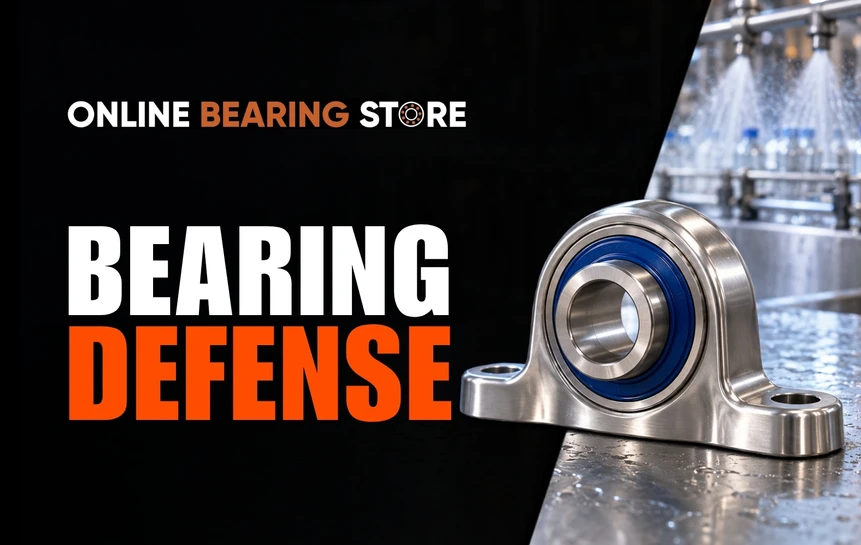
Washdown-Duty Bearings: What IP Rating and Seal Type You Need for CIP Cycles
Installing a standard off-the-shelf bearing on a line with frequent Clean-in-Place (CIP) washdowns is a quick way to guarantee premature seal failure, grease washout, and thousands of dollars in unexpected downtime. Protecting your processing line requires matching both the Ingress Protection (IP) rating and the mechanical seal design to your exact washdown intensity, rather than relying on a generic "washdown-rated" label.
Why Do CIP Washdown Cycles Require Specialized Bearings?
Clean-in-Place (CIP) routines are non-negotiable for food, beverage, and pharmaceutical processing. They sanitize equipment without requiring full teardowns, ensuring strict hygiene standards. However, the exact conditions that destroy bacteria can also destroy standard industrial bearings in a matter of weeks.
High-Pressure Spray and Chemical Exposure
During a typical CIP cycle, automated spray balls and manual washdown wands blast bearing assemblies with hot water at pressures up to 1,500 PSI or higher. These streams often contain aggressive cleaning agents, such as sodium hydroxide (caustic soda), peracetic acid, or nitric acid. Standard rubber seals are not built to withstand this combined mechanical and chemical assault. Over time, the chemicals degrade the elastomer, causing it to crack or swell, while high-pressure water jets cut right past worn sealing lips.
Thermal Cycling During CIP
Bearings experience severe thermal shocks during cleaning. A production line running at ambient or chilled temperatures might suddenly be flooded with 180°F (82°C) sanitizing solution, followed almost immediately by a cold-water rinse. Metal housings and internal components expand and contract at different rates during these swings. As hot air inside the bearing housing rapidly cools during the rinse, it contracts and creates an internal vacuum. This suction pulls external water, foam, and trapped debris past rubber seals and directly into the bearing race.
Water and Contaminant Ingress Risk
Bearings located in direct splash zones, such as under conveyor belts, near filling heads, or beside mixing vats, face constant exposure to liquids. When washwater breaches the outer seal, it mixes with the internal grease, causing emulsification. Moisture breaks down the lubricant's film strength, leading to metal-on-metal contact, accelerated rust, micro-pitting on raceways, and total bearing seizure.
What Is an IP Rating and Why Does It Matter for Bearings?
An Ingress Protection (IP) rating is an international standard (IEC 60529 / DIN 40050-9) that defines how effectively an enclosure or mechanical component prevents the entry of foreign bodies and liquids. Understanding these codes helps maintenance and design engineers choose bearings that withstand specific plant environments.
How to Read an IP Code
An IP rating consists of two digits following the "IP" prefix:
- First Digit (Solid Ingress): Evaluates protection against solid objects, ranging from large hands (1) to fine, invisible dust particles (6). A rating of 6 indicates a completely dust-tight unit.
- Second Digit (Liquid Ingress): Evaluates protection against fluids, ranging from dripping water (1) to high-pressure, high-temperature jets (9K).
IP66 vs IP67 vs IP69K: What Each One Actually Covers
Understanding the practical differences between common IP ratings prevents costly specification errors:
- IP66: Protects against powerful water jets (up to 14.5 PSI at 100 liters per minute) from any direction. Suitable for standard washdowns where hoses are used from a distance.
- IP67: Protects against temporary water immersion (up to 1 meter depth for 30 minutes). Ideal for equipment submerged during static soaking or located in low drainage zones. However, IP67 does not guarantee protection against high-pressure water spray.
- IP69K: Represents the gold standard for hygienic processing. It certifies that the unit withstands close-range, high-pressure (1,450 to 1,740 PSI) water jets at elevated temperatures (up to 176°F / 80°C) delivered at multiple spray angles.
Matching IP Rating to Washdown Intensity
Selecting the correct IP rating depends entirely on where the bearing sits on the line. An IP65 or IP66 bearing works well in dry packaging zones or secondary processing areas subject to light spray. However, any bearing mounted near direct CIP spray zones, automated nozzles, or daily high-pressure sanitations require an IP69K rating to prevent premature failure.
Which Seal Types Perform Best in CIP Cycles?
While an IP rating measures overall ingress protection, the seal design is the physical barrier that makes that protection possible. Evaluating both specifications together is critical for reliable performance.
Contact Seals vs Non-Contact Seals
- Contact Seals: The sealing lip makes direct contact with the inner ring or shaft surface. This provides an excellent barrier against static liquids, but the physical contact creates friction, generates heat, and wears down over time at higher shaft speeds.
- Non-Contact Seals: Maintain a narrow clearance gap between the rotating and stationary components. They generate no friction heat and suffer zero wear but rely entirely on geometry or grease barriers to stop fluid entry.
Labyrinth Seals for High-Pressure Washdown
Labyrinth seals are non-contact barriers that use a series of intricate, interlocking internal turns and channels. When pressurized water hits a labyrinth seal, it loses velocity and energy as it forces its way through the tortuous path. Internal drainage channels direct the spent washwater out of the housing before it ever reaches the bearing raceway.
V-Ring and Triple-Lip Seal Designs
- V-Ring Slingers: An elastomer V-ring mounts directly onto the shaft and rotates with it. The flexible sealing lip rides against the housing end-face, acting as an external deflector that flings incoming washwater away from the primary internal seal.
- Triple-Lip Seals: Incorporates three distinct elastomeric contact lips in a single assembly. The outer lip deflects high-pressure washwater, the middle lip acts as a secondary barrier against trapped moisture, and the inner lip retains the internal food-grade grease.
|
Seal Type |
Primary Mechanism |
Pros |
Cons |
Recommended CIP Intensity |
|
Single Contact Seal |
Single rubber lip against inner ring |
Low initial cost, compact design |
Wears rapidly; fails under direct spray |
Light splash, non-CIP zones |
|
Labyrinth Seal |
Interlocking non-contact fluid paths |
No friction heat, zero lip wear |
Relies on complex channels & grease back-up |
High-speed lines; moderate CIP |
|
V-Ring Slinger |
Shaft-mounted rotating flinger |
Excellent outer spray deflector |
Requires extra axial shaft space |
Secondary barrier for IP66/IP67 |
|
Triple-Lip Seal |
Three sequential contact barriers |
Maximum liquid & chemical defense |
Slightly higher running drag |
Daily heavy-duty IP69K CIP |
How Does CIP Exposure Affect Bearing Material and Housing Selection?
Even the most advanced triple-lip seal will fail if the surrounding housing or internal rolling elements degrade under chemical attack.
Stainless Steel vs Coated Carbon Steel
- Coated Carbon Steel: Cast iron housings treated with epoxy coatings or nickel plating are cost-effective initially. However, high-pressure washdown eventually chips the coating or causes micro-cracks. Once moisture reaches the raw iron beneath, rust spreads, flaking off into clean food processing zones.
- Stainless Steel Bearings: Housings made from 304 or 316 grade stainless steel, paired with 440C stainless steel rolling elements, offer total corrosion resistance. They withstand harsh caustic or acid cleaners without flaking, peeling, or rusting.
Polymer and Composite Housing Options
High-strength thermoplastic and PBT composite housings provide an excellent alternative to metal. They are completely rust-proof, highly resistant to aggressive cleaning compounds, and molded with smooth, non-porous surface finishes that prevent bacterial attachment.
Corrosion Resistance and Fastener Considerations
Failure often occurs at the hardware connections rather than the main housing. Carbon steel mounting bolts, set screws, or grease fittings corrode quickly in wet CIP environments. Always specify 316 stainless steel mounting hardware, grease zerk fittings, and end covers to ensure long service life and easy maintenance teardowns.
How Do You Choose the Right IP Rating and Seal Combination for Your Application?
Selecting the optimal washdown bearing requires assessing operating conditions rather than relying on standard part numbers.
Assessing Wash Frequency and Pressure
Determine the exact sanitation routine used in your facility:
- Light Duty: Weekly manual hose-downs at low pressure (<100 PSI) → IP65/IP66 with dual-lip contact seals.
- Medium Duty: Daily manual washdowns with warm water and mild detergent (100–500 PSI) → IP67/IP68 with V-ring deflector and contact seal.
- Heavy Duty / CIP: Automated or close-range high-pressure (>1,000 PSI), high-temperature (176°F) cleaning with caustic foam → IP69K certified units with triple-lip or labyrinth-slinger combination seals.
Evaluating Chemical and Cleaning Agent Compatibility
Review the Safety Data Sheets (SDS) for your plant’s sanitation chemicals. Standard Nitrile (NBR) rubber handles general washdown well, but exposed environments with high ozone, concentrated acids, or elevated temperatures may require Viton™ (FKM), EPDM, or specialty fluoropolymer seal compounds.
Balancing Protection Against Cost
Over-specifying every bearing on a line with IP69K stainless steel units increases initial capital costs unnecessarily. Focus high-end IP69K units on direct food-contact zones and areas exposed to primary CIP spray. Use standard IP65/IP66 composite units in dry zones or secondary handling equipment further down the line.
What Are the Most Common Failure Points in Washdown Bearing Applications?
Recognizing early warning signs helps prevent catastrophic equipment breakdown on the plant floor.
Seal Degradation from Repeated Thermal Cycling
Rapid heating and cooling hardens rubber seal compounds, destroying their flexibility. Once the seal loses resilience, it can no longer maintain contact with the rotating shaft, allowing washwater to bypass the barrier during thermal vacuum events.
Grease Washout and Relubrication Challenges
Water ingress thins internal grease, washing it out of the bearing cavity. Running unlubricated bearings creates extreme friction, leading to raceway galling, spalling, and total failure. Using bearings pre-filled with NSF H1 food-grade grease or solid lubricant blocks helps prevent grease displacement.
Housing Corrosion and Fastener Failure
Rough housing castings feature crevices that collect moisture, organic matter, and cleaning chemicals. Over time, crevice corrosion weakens the mounting feet or cracks the housing, causing shaft misalignment and sudden bearing lockup.
What Washdown-Duty Bearing Solutions Does Online Bearing Store Offer?
Online Bearing Store supplies washdown-duty bearing assemblies specifically engineered for harsh food, beverage, and pharmaceutical processing environments.
Stainless Steel and High-IP-Rated Bearing Units
Our inventory includes 304 and 316 stainless steel mounted units (pillow blocks, 2-bolt flanges, and 4-bolt flanges) certified up to IP69K. These units feature solid-base designs without open pockets or cavities, eliminating bacterial traps and ensuring full compliance with HACCP and USDA guidelines.
Advanced Sealing Options for Hygienic Environments
We stock insert bearings equipped with advanced sealing systems, including triple-lip contact seals, stainless steel slingers, and hybrid labyrinth designs. Pre-filled with premium NSF H1 food-grade grease, these units resist water washout and chemical degradation across extended maintenance intervals.
Expert Guidance for Washdown Application Specification
Not sure which IP rating or seal material fits your specific line setup? The technical team at Online Bearing Store provides application reviews to help you match bearing housings, internal seals, and lubricants to your plant’s exact CIP washdown routine.
Get the Right Protection for Your Washdown Application
Do not let premature bearing failure cut into your production line uptime. Upgrading to the correct IP-rated, corrosion-resistant washdown bearings protects your equipment against high-pressure water, chemical corrosion, and grease washout.
Explore our full inventory of stainless steel washdown bearings, or contact our technical sales team at Online Bearing Store for an expert CIP application review today.
Frequently Asked Questions (FAQ)
1. What is the main difference between IP67 and IP69K bearing ratings?
IP67 rates a bearing for protection against temporary liquid submersion up to 1 meter for 30 minutes. IP69K rates a bearing for close-range, high-pressure (up to 1,740 PSI), high-temperature (176°F) water spray. For CIP cycles with spray wands or automated nozzles, IP69K is required.
2. Can high-pressure water washouts remove internal bearing grease?
Yes. High-pressure water easily penetrates basic single-lip rubber seals, diluting or washing away standard grease. This leaves internal rolling elements running metal-on-metal, causing rapid overheating and premature failure.
3. Why are standard rubber contact seals insufficient for CIP washdown applications?
Standard rubber seals degrade when exposed to harsh CIP chemicals like sodium hydroxide or peracetic acid. Additionally, high-pressure spray bends flexible single lips inward, opening a direct pathway for water and chemical ingress.
4. What isa thermalvacuum effect in washdown bearings?
When a warm bearing is hit with cold washdown water, the air inside the housing contracts rapidly as it cools. This pressure drop creates an internal vacuum that actively sucks external washwater, foam, and debris past weak seals into the bearing cavity.
5. Are polymer composite housings strong enough to replace stainless steel?
Yes, high-strength thermoplastic and PBT composite housings handle significant radial loads in food and beverage processing. They are completely rust-proof, highly chemical-resistant, and cost less than solid stainless steel housings.
6. What type of grease should be used in washdown-duty bearings?
Washdown bearings should use NSF H1 food-grade grease, which is safe for incidental food contact. For intense CIP zones, choose greases formulated with synthetic base oils and aluminum complex or calcium sulfonate thickeners, which resist water washout and oxidation.
7. How does a labyrinth seal block pressurized water without touching the shaft?
A labyrinth seal uses interlocking internal turns and channels. As high-pressure water enters the outer gap, it is forced through multiple 90-degree turns, losing velocity and pressure before draining safely out through relief ports.
8. Is an IP69K rating alone enough to guaranteelongbearing life?
No. An IP rating certifies liquid protection at a specific point in time, but it does not measure chemical compatibility or housing corrosion resistance. Long bearing life requires combining an IP69K rating with stainless or composite housing materials and chemical-resistant seal compounds.
9. Why is a solid-basehousing design important for hygienic areas?
Standard cast housings have hollow pockets on their underside that collect water, food particles, and cleaning chemical residue, creating breeding grounds for bacteria like Listeria. Solid-base housings eliminate these cavities for easy cleaning.
10. How do I know if my bearing failure was caused by grease washout versus chemical degradation?
Grease washout leaves raceways dry, rusted, or covered in a milky, emulsified paste. Chemical degradation causes the rubber seal lips to harden, crack, crumble, or swell prior to internal mechanical failure.