
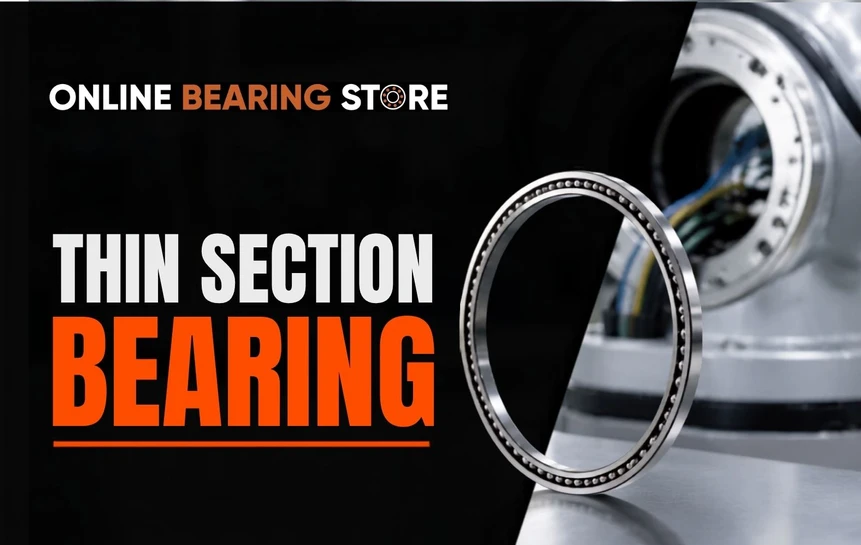
Thin Section Ball Bearings: Applications Where Compact Geometry Is Non-Negotiable
When you are designing a collaborative robot joint that must deliver full rotational performance inside a housing shell only millimeters thick, trying to stuff a standard bearing into that tight envelope will instantly stall your design. That is where thin section ball bearings come in: they are the purpose built solution for high performance equipment where space, weight, and geometry are strict, non-negotiable constraints.
What Are Thin Section Ball Bearings?
A thin section ball bearing is a precision component engineered to keep its radial profile as thin as possible, even as the center hole gets larger. In traditional power transmission setups, bigger shafts mean bigger, heavier bearings. Thin section designs break that rule by prioritizing physical clearance and weight efficiency over sheer metal mass. Engineers relying on thin section bearings know that smart geometry solves tight space issues.
Constant Cross Section Design
Unlike standard bearings that grow thicker and wider as bore sizes expand, constant cross section bearings maintain the exact same cross sectional dimensions across an entire product family. Whether you specify a 1 inch bore or a 12 inch bore within a given series, the radial height and axial width of the bearing rings stay completely unchanged. This unique trait gives you total predictability during CAD layout, because scaling up your shaft size does not force you to redesign your outer housing or recalculate your spatial envelope. Integrating thin section bearings into your design keeps overall machine dimensions completely manageable.
Bore to OD Ratio and Space Savings
The standout physical feature of thin section bearings is their remarkably high bore to outer diameter (OD) ratio. Because the distance between the inner ring and outer ring is kept to a bare minimum, you gain a massive internal opening relative to the total space the bearing occupies. This high ratio frees up valuable interior volume that would otherwise be filled with solid steel rings, directly reducing overall component weight and leaving ample clearance for internal drive mechanisms. Upgrading to compact ball bearings makes space optimization straightforward.
Common Cross Section Series
Manufacturers standardize thin section bearings into distinct cross section families to help engineers match mechanical strength with spatial bounds. Utilizing lightweight ball bearings keeps structural load high while dropping assembly mass. The three primary imperial standard series include:
- Extra Light Series (1/4" / 6.35 mm cross section): Built for severe space restrictions and light structural loads where minimal torque and maximum compactness rule the design. These thin wall bearings work best in delicate assemblies.
- Light Series (3/8" / 9.525 mm cross section): The workhorse choice that balances small outer dimensions with moderate load carrying capability for general automation.
- Medium Series (1/2" / 12.7 mm cross section): Features larger rolling elements to deliver higher rigidity and load support while still keeping a significantly slimmer profile than conventional bearings.
Why Does Compact Geometry Matter in Bearing Selection?
Choosing a bearing is rarely just about supporting a shaft: it dictates the physical size, thermal profile, and efficiency of your entire assembly. When working with tight mechanical bounds, compact bearing geometry becomes the foundational element that makes advanced machine designs possible. Exploring thin section bearing applications helps highlight where space savings matter most.
Space Constrained Housings
In modern product design, physical footprints are shrinking while performance expectations keep climbing. Medical equipment, airborne platforms, and automated production machinery often have fixed outer shells where every millimeter of radial or axial space is aggressively optimized. Integrating compact ball bearings allows you to preserve critical wall thickness in surrounding housings without sacrificing the internal shaft dimensions required to handle operational torque. Reviewing standard thin section bearing sizes ensures your housing fits like a glove.
Weight Reduction Requirements
In any moving system, excess mass creates a cascading engineering penalty. Heavy components demand larger drive motors, consume more electrical power, generate unwanted heat, and slow down dynamic response times. Incorporating thin wall bearings into rotary systems cuts component mass significantly, frequently yielding weight savings of up to 80% compared to traditional deep groove bearings of identical bore diameter. In portable equipment, relying on lightweight ball bearings translates directly into longer battery life and faster cycle times.
Enabling Hollow Shaft and Pass Through Designs
Standard small bore bearings force you to run wiring, air lines, and mechanical linkages around the outside of rotating joints, leaving sensitive cables exposed to snags, friction, and environmental wear. Utilizing lightweight ball bearings with oversized bore diameters opens up a clear central passage. You can route electrical wiring, fluid conduits, fiber optics, or slip rings straight through the rotational axis, creating a cleaner, more reliable, and completely enclosed system. Following a clear thin section bearing selection guide helps clear the path for hollow shaft routing.
Comparing Thin Section vs. Standard Bearing Geometry
To visualize how thin section bearings save space as shaft diameters scale up, examine the structural differences across common bore sizes. Selecting precision thin section bearings ensures smooth performance across every dimensional bracket.
|
Feature / Dimensional Metric |
Standard Deep Groove Bearing (6200 Series) |
Thin Section Bearing (1/4" Cross Section Series) |
|
50 mm Bore Outer Diameter / Width |
90 mm OD / 20 mm Width |
62.7 mm OD / 6.35 mm Width |
|
100 mm Bore Outer Diameter / Width |
180 mm OD / 34 mm Width |
112.7 mm OD / 6.35 mm Width |
|
200 mm Bore Outer Diameter / Width |
360 mm OD / 58 mm Width |
212.7 mm OD / 6.35 mm Width |
|
Cross Section Behavior |
Scales up aggressively with bore size |
Remains strictly constant at 6.35 mm x 6.35 mm |
|
Bore to OD Ratio |
Low (typically 0.55 to 0.58) |
High to extremely high (0.80 to 0.94+) |
|
Volumetric Profile |
Heavy, solid metal structure |
Compact, ring focused geometry |
|
Internal Pass Through Room |
Severely restricted by thick ring walls |
Maximized for center line routing |
Which Industries Rely on Thin Section Bearings?
When product specifications leave zero margin for structural bulk, thin section bearings become mandatory mechanical components across several advanced technology sectors. Understanding typical thin section bearing applications helps narrow down product selection.
Robotics and Automation Joints
Collaborative robots, articulated arms, and rotary actuators demand maximum power density packed into streamlined joints. Installing dedicated robotic joint bearings ensures high torque capacity inside tight wrist and elbow shells. Thin section bearings with four point contact profiles are especially popular here because a single bearing can carry combined radial, thrust, and moment loads inside a micro sized housing envelope.
Medical Imaging and Diagnostic Equipment
In medical hardware such as CT scanners, C-arms, and robotic surgical tables, motion must be silent, precise, and extremely reliable. Large diameter gantries rely on thin section bearing applications to support heavy rotating rings while providing a huge central opening for the patient bore and high speed optical data channels. Integrating precision thin section bearings keeps rotational noise and runout to absolute minimums.
Aerospace and Satellite Systems
For space instruments, target tracking gimbals, optical positioners, and solar array drives, payload weight is directly tied to launch costs. Utilizing precision thin section bearings manufactured from specialized stainless steels or beryllium copper delivers smooth, low friction rotation in extreme temperatures and high vacuum environments, all while shaving crucial pounds off the flight assembly. Choosing lightweight ball bearings ensures maximum launch payload capacity.
Semiconductor and Precision Manufacturing
Microchip fabrication tools operate in ultraclean environments where submicron accuracy is standard. Wafer handling arms, rotary indexing tables, and vacuum chambers utilize thin wall bearings to maintain low overall height profiles. Using precision thin section bearings minimizes vibration during rapid arm indexing, protecting delicate silicon wafers during high speed transfers.
Thin Section Series Reference Guide
Selecting the ideal series requires balancing available envelope space against operational forces. Consulting a thin section bearing selection guide streamlines your component matching:
|
Series Designation |
Cross Section Dimensions |
Common Bore Range |
Load & Stiffness Profile |
Typical Application Focus |
|
Extra Light (A-Type / KAA) |
3/16" to 1/4" (4.76 to 6.35 mm) |
1.0" to 12.0" (25 to 300 mm) |
Light load capability; lowest torque and mass |
Small gimbals, handheld optical tools, encoder mounts |
|
Light (B-Type / KB) |
5/16" to 3/8" (7.94 to 9.52 mm) |
1.0" to 20.0" (25 to 500 mm) |
Moderate load capability; balanced rigidity |
Cobot joints, medical positioning stages, camera mounts |
|
Medium (C-Type / KC to KG) |
1/2" to 1.0" (12.7 to 25.4 mm) |
4.0" to 40.0" (100 to 1000 mm) |
High load capability; maximum moment stiffness |
Industrial rotary tables, radar pedestals, heavy actuators |
How Do Thin Section Bearings Differ from Standard Ball Bearings?
While thin section bearings solve severe spatial headaches, they behave quite differently from heavy duty traditional bearings under mechanical load. Understanding these differences is essential for long term operational success. Comparing constant cross section bearings to variable standard profiles clarifies performance expectations.
Load Capacity and Deflection Trade Offs
Standard ball bearings rely on deep raceways and large rolling elements to absorb heavy impact and radial forces without flexing. Thin section bearings utilize smaller balls and narrower rings, which naturally reduces their raw radial load rating compared to a standard bearing with an identical bore diameter. However, because thin wall bearings allow you to run a much larger, stiffer shaft through the center, the increased rigidity of the shaft itself often offsets the reduced bearing capacity, resulting in a stiffer overall system assembly.
Mounting and Housing Rigidity Requirements
A conventional bearing ring possesses enough structural mass to hold its own roundness under load. By contrast, a thin section bearing ring is intentionally slender and relatively flexible. When unmounted, these thin wall bearings can actually conform slightly to external handling pressure. This means the bearing relies directly on the surrounding housing and shaft to establish its final round tolerance and operational geometry. If your housing bore is slightly out of round, compact ball bearings will flex into that flawed shape, leading to tight spots and early wear.
Runout and Precision Considerations
Because ring wall thickness is so small, manufacturing tolerances must be held to extremely strict limits. Precision thin section bearings are typically crafted to high precision standards (such as ABEC 5 or ABEC 7 / ISO P5 or P4). Maintaining tight radial and axial runout control ensures that despite the delicate cross section, thin section bearings deliver consistent rotational accuracy, minimal torque ripple, and precise positioning in sensitive optical and robotic gearboxes.
What Should Engineers Consider When Selecting a Thin Section Bearing?
Proper bearing specification requires reviewing environmental conditions, structural support, and force vectors together. Referencing a thin section bearing selection guide keeps your design process organized and precise.
Choosing the Right Cross Section Series
Follow a structured thin section bearing selection guide process: match your required shaft size against available cross section envelopes. Check standard thin section bearing sizes early in design. If your design prioritizes minimal mass and ultra low starting torque over extreme force resistance, start with an Extra Light series using lightweight ball bearings. If you face heavy moment loads, step up to a Light or Medium cross section for increased rigidity.
Radial, Axial, and Moment Load Requirements
Thin section bearings generally come in three distinct contact styles:
- Radial Contact (Type C): Features a deep groove raceway optimized for pure radial loads, though it can support light thrust forces in both directions.
- Angular Contact (Type A): Designed with a high contact angle to manage heavy unidirectional thrust loads. These are typically installed in preloaded, back to back pairs.
- Four Point Contact (Type X): Uses a distinct Gothic arch raceway profile that enables a single row of balls to handle radial, axial, and moment loads simultaneously, serving as compact robotic joint bearings.
Sealing and Lubrication in Compact Designs
Because space inside the bearing cavity is extremely limited, choosing the right sealing and lubrication setup is vital for operational life. Many thin wall bearings are available with integrated rubber seals or noncontact metal shields that lock in synthetic greases without adding bulk. For vacuum, cleanroom, or aerospace environments, specialty dry film lubricants or low outgassing synthetic oils are specified to keep operating torque low in precision thin section bearings.
What Are Common Mistakes When Specifying Thin Section Bearings?
Even seasoned engineering teams can run into trouble when working with thin section bearings for the first time. Reviewing available thin section bearing sizes helps avoid improper spatial fits.
Underestimating Housing Rigidity Needs
The most frequent specification error is placing thin wall bearings inside a soft or overly thin housing structure. If your aluminum or composite housing deforms under working loads, the flexible bearing ring deforms along with it. This creates localized stress concentrations on the internal balls, leading to sudden noise and rapid raceway wear in compact ball bearings. Always ensure your support structures provide uniform, rigid circumferential clamping.
Overlooking Preload and Internal Clearance
Specifying the wrong internal clearance can ruin an otherwise flawless design. Excessive radial clearance permits tipping under moment loads, which damages precision gear alignment in robotic joint bearings. Conversely, applying too much manual preload without accounting for thermal expansion can crush the rolling elements, driving up friction and drastically shortening operating life. Consulting a thin section bearing selection guide prevents these clearance errors.
Ignoring Thermal Expansion Effects
Thin steel bearing rings expand and contract quickly when ambient temperatures fluctuate. If you mount steel thin section bearings into an aluminum housing without calculating differential thermal expansion, a rise in operating temperature can cause the housing to expand faster than the bearing, loosening your critical fit. Reviewing thermal limits across all thin section bearing sizes ensures smooth operation in variable environments.
Thin Section Ball Bearings from Online Bearing Store
When your design requires compact geometry without sacrificing rotational precision, Online Bearing Store delivers the extensive product availability and technical guidance your project demands.
Extra Light, Light, and Medium Series in Stock
We maintain a broad inventory across all standard thin section bearing sizes in imperial and metric series, ready for rapid dispatch:
- Bore diameters ranging from 1.0 inch up to 40 inches.
- Open, shielded, and sealed options in compact ball bearings.
- High grade chrome steel and corrosion resistant stainless steel variants.
- Complete availability across Type C, Type A, and Type X raceway designs in constant cross section bearings.
Custom and Application Specific Configurations
Have specialized application requirements? Whether your project calls for ceramic hybrid balls, custom contact angles, specialized cleanroom greases, or precision thin section bearings, we work closely with leading manufacturers to supply tailor made components. You can explore our dedicated robotics and automation bearing solutions to find targeted robotic joint bearings designed for complex articulated joints and precision rotary drives.
Engineering Support for Compact Bearing Applications
Selecting and integrating thin wall bearings requires careful attention to detail. Our technical support specialists are ready to review your CAD models, evaluate combined load scenarios, help you calculate L10 bearing life, and recommend precise shaft and housing fits for all thin section bearing applications.
Frequently Asked Questions (FAQ)
1. What is the main structural advantage of constant cross section bearings?
The primary advantage of constant cross section bearings is their predictable geometry. Unlike standard bearings that get larger and heavier as the inner hole grows, these bearings keep the same small profile regardless of bore size. This provides a huge center pass through opening while keeping total machinery size and weight exceptionally low.
2. Can a singlefourpoint contact bearing handle combined loads in robotic joint bearings?
Yes, in many setups. By choosing a four point contact (Type X) bearing profile, a single row of balls can support radial loads, double direction thrust loads, and tilting moment loads all at once. This frequently allows robotic joint bearings to consolidate two standard bearings into a single, highly compact joint assembly.
3. Why is housing rigidity so important when installing thin wall bearings?
Because thin wall bearings have slender rings, they lack the structural mass to stay perfectly round on their own. They naturally conform to the geometry of the housing bore and shaft. If your housing is weak or out of round, compact ball bearings will flex into that improper shape, causing binding, elevated friction, and early failure.
4. How do Ideterminewhether to use an Extra Light, Light, or Medium series in a thin section bearing selection guide?
Base your decision on available spatial bounds and required load capacity. Extra Light series works best for tight spaces requiring lightweight ball bearings. Light series offers an ideal middle ground for general automation and robotics. Medium series provides maximum stiffness and load capability for heavy duty rotary stages.
5. Are precision thin section bearings capable of running at high rotational speeds?
Yes, provided they are properly lubricated and preloaded. Because precision thin section bearings utilize smaller rolling elements, they generate less centrifugal force at speed than heavy standard bearings. However, precise alignment and heat dissipation must be managed to prevent thermal expansion issues.
6. What are the most common thin section bearing applications?
Popular thin section bearing applications include collaborative robot joints, medical imaging gantries, satellite antenna gimbals, semiconductor wafer handling stages, and rotary indexing tables. Any application where space and weight are strictly limited relies heavily on these compact components.
7. How does a hollowshaft passthrough design benefit compact ball bearings setups?
A hollow shaft design allows you to route electrical wiring, fluid tubing, fiber optic lines, or secondary mechanical drives directly through the center axis of compact ball bearings. This eliminates messy external wiring harnesses, protects cables from friction wear, and reduces overall machine dimensions.
8. What materials are commonly used for lightweight ball bearings?
High carbon 52100 chrome steel is the standard choice for general industrial use due to its excellent fatigue resistance. 440C stainless steel is widely specified for aerospace and medical lightweight ball bearings where corrosion resistance or vacuum compatibility is required. Ceramic hybrid configurations are also used for high speed or low lubrication environments.
9. What catalog options exist for standard thin section bearing sizes?
Standard thin section bearing sizes range from 1 inch bore diameters up to 40 inches or more. Across these sizes, cross sections remain fixed at standard dimensions such as 1/4", 3/8", and 1/2", allowing engineers to scale shaft diameters without increasing bearing profile height.
10. Can thin wall bearings handle heavy shock loads?
Because thin wall bearings use smaller rolling elements and thinner rings, they have lower static shock capacity than heavy standard bearings of the same bore size. If heavy shock loads are expected, you should step up to a larger cross section series, utilize ceramic rolling elements, or consult with an application engineer to evaluate load distribution across the raceway.
Find the Right Thin Section Bearing for Your Application
Do not let bulky standard bearings restrict your engineering vision. Whether you are developing collaborative robot arms, lightweight aerospace gimbals, or high precision medical gantries, thin section bearings deliver the compact geometry and reliable performance your hardware needs.
Ready to find the ideal match for your assembly? Browse our full inventory on the Online Bearing Store Thin Section Bearing Category Page to compare series specifications, dimensions, and load ratings across all thin section bearing sizes.
If you need technical assistance verifying fits, preloads, or load calculations for your project, Contact Online Bearing Store's Technical Team today to speak directly with an application expert.