
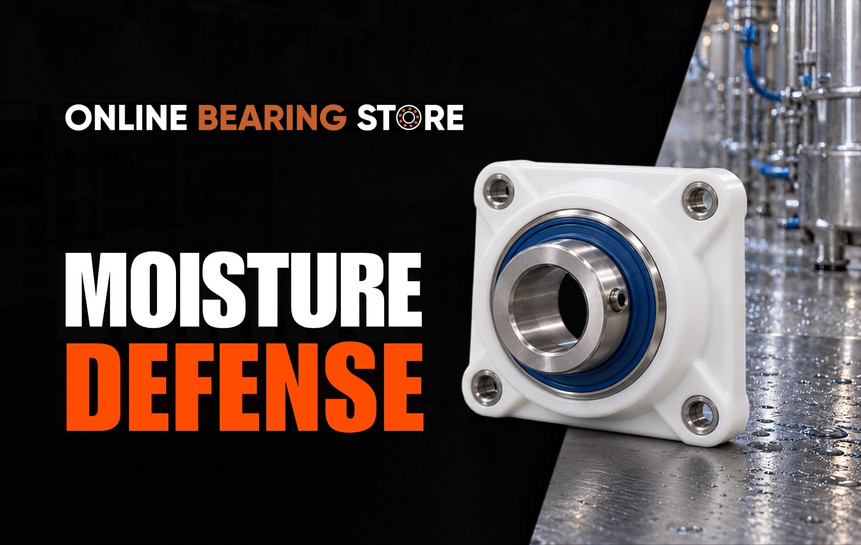
Stainless Insert Bearings for Washdown Applications: What to Check Before You Buy
When a food plant swapped out its rusted chrome steel pillow blocks for shiny new stainless units, the team assumed their sanitation headaches were finally over, but six months later those bearings were grinding to a halt anyway. Daily high-pressure cleaning drives water past standard seals, degrades internal grease, triggers thermal shock, and causes chemical corrosion that destroys internal components despite a rust-free outer shell. This guide walks you through a practical pre-purchase checklist covering material grades, seal configurations, load limits, and housing designs so you can learn how to choose washdown bearings that last, specifically selecting true washdown duty bearings for your equipment.
Why Do Standard Insert Bearings Fail in Washdown Environments?
Water Intrusion Past the Seals.
High-pressure washdown spray routinely blasts past single-lip rubber contact seals, forcing water directly into the bearing cavity where it quickly mixes with grease. Once emulsified, the grease loses its ability to lubricate internal raceways, causing rapid metal-to-metal contact, friction, and heat buildup. Over a short period, this water ingress causes severe internal surface pitting and forces early mechanical replacement long before the bearing reaches its rated fatigue life. Understanding how to choose washdown bearings starts with recognizing how bearing corrosion in washdown environments destroys standard components.
Corrosion of Rings, Balls, and Hardware.
Standard chrome steel inserts corrode rapidly when exposed to water, cleaning chemicals, and ambient humidity. Rust forms across polished rolling tracks and balls, creating microscopic rough spots that cause severe vibration, shaft galling, and eventual seizure. Even if the bearing housing looks clean on the outside, corroded set screws and locking collars can lock onto the shaft, making routine maintenance difficult. This is why plants switch to stainless steel insert bearings and corrosion resistant insert bearings.
Chemical and Thermal Attack.
Aggressive cleaning routines use caustic detergents, chlorinated sanitizers, and acid rinses that break down standard nitrile rubber seals over time. In addition, cold rinse water sprayed onto warm equipment creates thermal shock, dropping internal temperatures, and creating a vacuum effect inside the housing cavity. This suction actively pulls standing washwater and surface chemicals past degraded washdown bearing seals straight into the bearing tracks, creating severe bearing corrosion in washdown environments.
Which Stainless Steel Grade Should the Bearing and Housing Use?
440C Stainless for Bearing Rings and Balls.
Bearing rings and rolling elements need high surface hardness to withstand continuous heavy contact fatigue. Martensitic 440C stainless steel can be heat-treated to high hardness levels, providing strong wear resistance for heavy rotating loads in corrosion resistant insert bearings. However, because of its carbon content, 440C offers moderate corrosion resistance and can still show light surface staining under constant exposure to harsh acids or standing chemical sanitizers when evaluating 440C vs 316 stainless bearings.
304 vs. 316 Stainless for Housings.
Outer bearing housings do not handle internal rolling fatigue, which allows manufacturers to use austenitic stainless steel alloys focused purely on maximum corrosion protection. Grade 304 stainless offers solid protection against fresh water and standard detergents, making it a reliable workhorse for general food handling lines using stainless mounted bearing units. Grade 316 contains added molybdenum, giving stainless steel pillow block bearings superior protection against chlorides, salt spray, and aggressive acidic sanitizers used in heavy washdown zones. Understanding 440C vs 316 stainless bearings helps engineers select the right materials for stainless mounted bearing units.
Thermoplastic Housings with Stainless Inserts.
A thermoplastic housing stainless insert unit pairs a high-strength PBT polymer housing with stainless steel insert bearings. These solid polymer housings are lighter, lower in cost, and completely immune to rust, organic acids, and strong cleaning chemicals, making them popular washdown duty bearings. However, polymer materials have lower structural load limits and lower peak temperature ratings than solid metal housings, requiring careful verification when deciding how to choose washdown bearings.
|
Component / Material |
Corrosion Resistance |
Hardness & Load Capacity |
Chemical & Chloride Tolerance |
Typical Housing Use |
|
440C Stainless |
Moderate |
High (58–62 HRC) |
Moderate; avoid standing acids |
Internal insert bearing raceways and balls |
|
304 Stainless |
High |
Moderate (Un-hardened) |
Good; resists standard washdown |
General food processing and conveyor housings |
|
316 Stainless |
Superior |
Moderate (Un-hardened) |
Excellent; resists chlorides and acids |
Harsh chemical washdown and raw meat lines |
|
Thermoplastic (PBT) |
Superior (Immune) |
Moderate (Flex limits apply) |
Excellent; immune to rust |
High-moisture and direct-food contact areas |
Check out our guide on Food Grade Bearings: The Compliance and Selection Guide for Food Equipment Buyers to learn more about selecting compliant parts, including stainless mounted bearing units.
Does Switching to Stainless Reduce Load and Speed Capacity?
Why Stainless Ratings Run Lower Than Chrome Steel.
Stainless steel insert bearings carry lower dynamic and static load ratings than identical sizes made from premium chrome steel. Because 440C stainless steel cannot achieve the exact surface hardness or fatigue strength of alloy chrome steel, its load capacity is typically 15% to 20% lower. Assuming corrosion resistant insert bearings can handle the exact same load as a chrome steel bearing of the same size is a common reason for premature field failures when specifying washdown duty bearings.
How to Size Up When Converting an Existing Application.
When replacing chrome steel units with stainless steel insert bearings, review the actual operating loads instead of simply matching part numbers. Check the dynamic load rating on the manufacturer datasheet against conveyor belt tensions, peak product weights, and start-stop forces. If operating loads run close to the limits of a standard stainless insert, step up to the next shaft size or choose stainless steel pillow block bearings with a wide inner ring design to spread forces across a larger surface area and avoid bearing corrosion in washdown environments.
Speed and Temperature Limits Set by Seals and Lubricant.
In real-world stainless insert bearings washdown setups, maximum speed and temperature boundaries are limited by the contact seals and grease rather than the metal rings. Multi-lip rubber washdown bearing seals create noticeable rotational drag, generating internal friction and heat at high shaft RPMs. This friction, combined with synthetic grease temperature boundaries, often caps maximum operating speeds well before the steel reaches its mechanical fatigue threshold in stainless mounted bearing units.
What Seal Design Actually Keeps Wash Water Out?
Single-Lip vs. Triple-Lip Seals.
Single-lip contact seals rub lightly against the inner ring, creating low drag but offering little protection against high-pressure washdown spray. In contrast, triple-lip washdown bearing seals feature three elastomeric sealing edges bonded to a protective steel plate. These three barriers in series dramatically improve water resistance and prevent chemical ingress, making them essential for washdown duty bearings, though they introduce slightly higher rotational drag on stainless steel insert bearings.
Flingers and Labyrinth Features.
A stainless steel flinger sits on the inner ring outside the primary rubber seal and rotates alongside the shaft. Centrifugal action drives liquid, grit, and direct water spray outward and away from the seal lip. When paired with triple-lip washdown bearing seals, this setup forms a labyrinth path that shields delicate rubber sealing lips from the direct impact of high-pressure washdown nozzles in stainless steel pillow block bearings.
Open and Closed End Caps.
Polymer and stainless steel end caps attach directly to compatible stainless mounted bearing units to shield shaft ends and internal seals:
- Closed End Caps: Completely enclose the outer face of the bearing housing, blocking high-pressure water spray and protecting internal components from direct impacts and preventing bearing corrosion in washdown environments.
- Open End Caps: Incorporate an internal shaft seal lip that allows the shaft to pass through while keeping washwater out of corrosion resistant insert bearings.
Using end caps on a thermoplastic housing stainless insert unit also improves plant safety by covering exposed shafting.
|
Seal Design |
Water Resistance |
Drag & Heat |
High-Pressure Spray Rating |
Best Application Use |
|
Single-Lip Seal |
Fair |
Low |
Up to 200 PSI |
Light splash, dry packaging zones |
|
Triple-Lip Seal |
Superior |
Moderate |
Up to 1,000 PSI |
Direct washdown, humid processing |
|
Triple-Lip + Flinger |
Excellent |
Moderate to High |
Up to 1,500 PSI |
Heavy washdown, meat and poultry lines |
|
Triple-Lip + End Cap |
Maximum |
Moderate |
1,500 PSI+ (Shielded) |
Extreme washdown, full sanitation areas |
Read our article on UC vs. UE vs. UB Insert Bearing Series: What the Designations Actually Mean to learn more about matching insert series to specialized washdown bearing seals and learning how to choose washdown bearings.
How Should Washdown Bearings Be Lubricated and Relubricated?
Water-Resistant Grease Selection.
Standard industrial greases break down quickly when exposed to washdown spray, emulsifying into a watery mixture that fails to protect internal raceways. Washdown duty bearings require synthetic or aluminum-complex food-grade (H1) greases formulated specifically for high water-washout resistance. These heavy-duty greases cling to internal metal surfaces, resist chemical washdown, and prevent bearing corrosion in washdown environments within stainless steel pillow block bearings.
Relubricatable vs. Sealed-for-Life Units.
Sealed-for-Life units arrive factory-filled with a complete grease charge and heavy-duty washdown bearing seals, eliminating manual greasing errors and keeping contaminants out of your stainless steel insert bearings. Relubricatable units feature a grease fitting and internal channels that allow maintenance crews to push out old grease and moisture during routine service. Choosing between them depends on accessibility, sanitation schedules, and how to choose washdown bearings for specific plant zones.
Grease Fitting Placement and Purging.
Purging grease after a washdown cycle forces out any moisture or contaminants that may have worked past outer washdown bearing seals. Always use a manual grease gun and inject fresh grease slowly while the shaft is slowly rotating:
- Clean off the grease fitting and surrounding housing surface on your stainless mounted bearing units before attaching the hose.
- Pump grease in gradually until a small, clean bead of fresh lubricant shows around the seal lip.
- Avoid high-pressure pneumatic grease guns, which can blow seal lips off their seats and leave internal raceways of corrosion resistant insert bearings unprotected.
For insights on building robust processing equipment, consult How to Specify Anti-Bacterial Waterproof Bearings for a New Equipment Build when specifying a thermoplastic housing stainless insert assembly.
What Housing Design Features Matter for Sanitation?
Smooth, Crevice-Free Surfaces.
Standard cast iron housings have webbed support ribs, deep casting cavities, and rough textures that trap food particles, water, and bacteria, causing severe bearing corrosion in washdown environments. Sanitation-focused stainless mounted bearing units feature investment-cast 304/316 stainless or smooth thermoplastic bodies. Their smooth, rounded contours allow washwater to run off easily, helping maintenance teams clean stainless steel pillow block bearings faster during sanitation cycles.
Drainage and Mounting Orientation.
Mounting flat housing bases directly against equipment frames can create narrow gaps that trap water and harbor bacteria. Using solid-base stainless steel pillow block bearings eliminates hollow cavities under the unit where water can pool. Installing standoff spacers behind mounted flanges lifts stainless mounted bearing units slightly off the frame, allowing washwater and cleaning chemicals to drain away freely from washdown duty bearings.
Matching the Housing Style to the Frame.
Select a housing geometry that fits your frame layout and structural requirements:
- Pillow Block Units: Feature a two-bolt base for mounting stainless steel insert bearings onto flat horizontal structural frames.
- Flange Units: Available in two-bolt, three-bolt, and four-bolt styles for securing corrosion resistant insert bearings passing through vertical walls.
- Take-Up Units: Designed for conveyor tensioning frames that require smooth linear movement with a thermoplastic housing stainless insert setup.
To select the right housing style when learning how to choose washdown bearings, read our guide on How to Match an Insert Bearing to the Right Housing Without Guessing.
Are the Locking Hardware and Fasteners Stainless Too?
Set Screws and Collars.
Inexpensive washdown units sometimes use low-cost carbon steel set screws or locking collars to cut costs, leading to bearing corrosion in washdown environments. These non-stainless components rust quickly in high-moisture environments, seizing onto the shaft and galling the metal. Always confirm that set screws, eccentric collars, and internal retaining rings on your stainless steel insert bearings are made from 304 or 316 stainless steel when analyzing 440C vs 316 stainless bearings.
Mounting Bolts and Washers.
Fastening stainless steel pillow block bearings to a machine frame using standard zinc-plated carbon steel bolts creates a galvanic couple. When moisture and cleaning chemicals hit these dissimilar metals, galvanic action speeds up rust on the carbon steel bolts. Protect your stainless mounted bearing units by using 304 or 316 stainless steel mounting bolts, flat washers, and lock washers across all corrosion resistant insert bearings locations.
Locking Style Considerations.
The locking mechanism secures stainless steel insert bearings to the rotating shaft under vibration and shock loads. Set screw locking uses two stainless screws offset at 120 degrees, making it simple and effective for reversing drives in washdown duty bearings. Eccentric collars grip the shaft tightly in a single direction of rotation, while mechanical adapter sleeves provide strong concentric gripping for high-speed lines using washdown bearing seals.
To compare locking mechanisms in detail, see our article on Set Screw vs. Eccentric Locking Collar: Which Insert Bearing Locking System Holds Longer?.
What Should Your Pre-Purchase Checklist Include?
Material and Grade Confirmation.
Confirm that the internal rings and rolling elements use hardenable 440C stainless steel to support rolling loads when comparing 440C vs 316 stainless bearings. Also verify that housings, grease fittings, flingers, and set screws are made from 304 or 316 stainless steel—or solid thermoplastic—to help prevent rust in a thermoplastic housing stainless insert assembly.
Load, Speed, and Temperature Verification.
Check catalog dynamic and static load ratings against actual operating forces, applying a derating factor for stainless steel insert bearings. Confirm that maximum shaft RPMs and operating temperatures match the limits of your multi-lip washdown bearing seals and synthetic H1 food-grade grease used in washdown duty bearings.
Seal, Lubricant, and Serviceability Review.
Select multi-lip washdown bearing seals paired with stainless flingers or protective end caps to block high-pressure spray and stop bearing corrosion in washdown environments. Confirm whether factory pre-filled H1 grease matches your sanitation routines, and make sure grease fittings on your stainless mounted bearing units are easy to reach for routine purging when evaluating how to choose washdown bearings.
|
Inspection Point |
Specific Feature to Check |
Status |
|
Ring & Ball Material |
Confirm internal rings and balls are 440C stainless steel |
[ ] Verified |
|
Housing Material |
Confirm housing is 304/316 stainless steel or solid PBT thermoplastic |
[ ] Verified |
|
Sealing System |
Verify triple-lip contact seals with stainless flingers or end caps |
[ ] Verified |
|
Lubrication Type |
Confirm factory pre-fill with water-resistant H1 food-grade synthetic grease |
[ ] Verified |
|
Load Capacity |
Verify dynamic (C) and static (C0 ) load ratings cover derated operating loads |
[ ] Verified |
|
Housing Sanitation |
Check for smooth, crevice-free castings or solid flat-base designs |
[ ] Verified |
|
Hardware Grade |
Confirm set screws, collars, grease fittings, and bolts are stainless steel |
[ ] Verified |
For a broader look at corrosion resistant insert bearings, read our Guide to Insert Bearings: Selection, Fit, and Housing Compatibility to learn how to pair them with stainless steel pillow block bearings.
Where Can You Find Stainless Washdown Insert Bearings?
Stainless Insert Bearings by Series and Bore Size.
Online Bearing Store carries a wide stock of corrosion resistant insert bearings in common UC, UB, and SUC series across inch and metric bore sizes. These stainless steel insert bearings come equipped with multi-lip washdown bearing seals, stainless flingers, and factory-filled H1 food-grade grease for immediate installation in washdown duty bearings applications.
Stainless and Thermoplastic Housed Units.
Our inventory includes stainless steel pillow block bearings, 2-bolt and 4-bolt flange units, and take-up assemblies. Choose between investment-cast 304/316 stainless mounted bearing units for heavy structural loads or a thermoplastic housing stainless insert setup for rust-free operation in chemical zones where understanding 440C vs 316 stainless bearings matters most.
Accessories for Washdown Duty.
Complete your equipment build with polymer end caps, stainless steel grease fittings, standoffs, and 304/316 stainless mounting hardware for your washdown duty bearings. These accessories help protect your stainless mounted bearing units from water ingress, prevent bearing corrosion in washdown environments, and simplify routine cleaning.
Application Support.
If you need help converting chrome steel equipment to stainless insert bearings washdown units or sizing components for a new build, our technical support team is ready to assist. We can help you review load calculations, chemical compatibility, and part cross-references to teach you how to choose washdown bearings for your specific plant requirements.
Is Your Line Ready for Its Next Washdown?
Don't let water intrusion, rust, and premature bearing failures disrupt your production targets and drive up maintenance costs. Upgrading to properly specified stainless insert bearings washdown units protects your machinery and extends equipment service life. Explore our full catalog of stainless steel insert bearings, stainless steel pillow block bearings, and thermoplastic housing stainless insert units today at Online Bearing Store, or contact our engineering team for expert advice on how to choose washdown bearings for your next project!
Frequently Asked Questions
1. Can I put a stainless insert bearing into a standard cast iron housing?
Yes, as long as the insert series and bore size match the housing dimensioning (for example, a SUC205 insert inside a standard 205 cast iron housing). However, using cast iron in washdown zones means the housing will still suffer from bearing corrosion in washdown environments, flaking paint and harboring bacteria. For full sanitation performance, pair stainless steel insert bearings with stainless mounted bearing units or a thermoplastic housing stainless insert.
2. Why do 440C stainless steel insert bearings attract a magnet?
440C stainless steel is a martensitic alloy containing higher carbon content, allowing it to be heat-treated for high surface hardness in corrosion resistant insert bearings. When comparing 440C vs 316 stainless bearings, this heat treatment creates a magnetic internal structure. Austenitic stainless steels like 304 and 316 used in stainless steel pillow block bearings have different alloy compositions and are naturally non-magnetic.
3. How often should washdown bearings be greased in food processing areas?
Re-greasing intervals depend on shaft speed, operating temperature, and how often equipment undergoes washdown. In facilities with daily high-pressure washdown cycles, washdown duty bearings are typically purged weekly or monthly using small amounts of H1 food-grade grease while the shaft is rotating slowly to preserve washdown bearing seals.
4. What is the main difference between a stainless flinger and a rubber contact seal?
A rubber seal presses directly against the inner ring of stainless steel insert bearings to form a physical barrier against water and dirt. A stainless flinger is pressed onto the inner ring and rotates with the shaft, using centrifugal force to throw water and heavy washdown spray away from washdown bearing seals before water can enter stainless mounted bearing units.
5. Why are thermoplastic housingsa good choicefor chemical washdowns?
A thermoplastic housing stainless insert unit is solid, non-porous, and completely immune to rust, organic acids, and strong chemical sanitizers. Thermoplastic bodies do not chip, peel, or corrode over time, making them a lightweight and cost-effective choice for washdown duty bearings in harsh sanitation environments where learning how to choose washdown bearings is vital.
6. Do stainless insert bearings require special mounting bolts?
Yes, you should always use 304 or 316 stainless steel mounting bolts and washers when installing stainless steel pillow block bearings. Using standard carbon steel or zinc-plated bolts creates a galvanic couple that speeds up fastener rust in wet environments, complicating maintenance on stainless mounted bearing units.
7. How do I prevent thermal shock from sucking water into my bearings?
Thermal shock happens when cold rinse water hits warm washdown duty bearings, creating an internal vacuum that pulls water past seal lips and causes bearing corrosion in washdown environments. To prevent water ingress, use multi-lip washdown bearing seals paired with flingers or end caps on your corrosion resistant insert bearings.
8. What is the difference between 304 and 316 stainless steel housings?
When evaluating 440C vs 316 stainless bearings and housings, Grade 304 stainless steel provides strong protection against water and standard cleaning chemicals for general stainless mounted bearing units. Grade 316 stainless contains added molybdenum, offering higher resistance to chlorides, salt spray, and aggressive acids used on stainless steel pillow block bearings.
9. Can I use high-pressure pneumatic grease guns on washdown bearings?
It is best to avoid high-pressure pneumatic grease guns on washdown duty bearings. Rapid pressure spikes can blow rubber washdown bearing seals off their seating grooves, ruining the seal and exposing internal raceways of stainless steel insert bearings to washwater. Always use a manual grease gun on corrosion resistant insert bearings.
10. Why do stainless insert bearings carry lower load ratings than chrome steel units?
Martensitic 440C stainless steel used in stainless steel insert bearings cannot be heat-treated to the exact same hardness levels as premium 52100 chrome steel. Because surface hardness directly affects fatigue life under rolling contact, 440C inserts in stainless steel pillow block bearings carry load ratings roughly 15% to 20% lower than equivalent chrome steel units, a key consideration when deciding how to choose washdown bearings.