
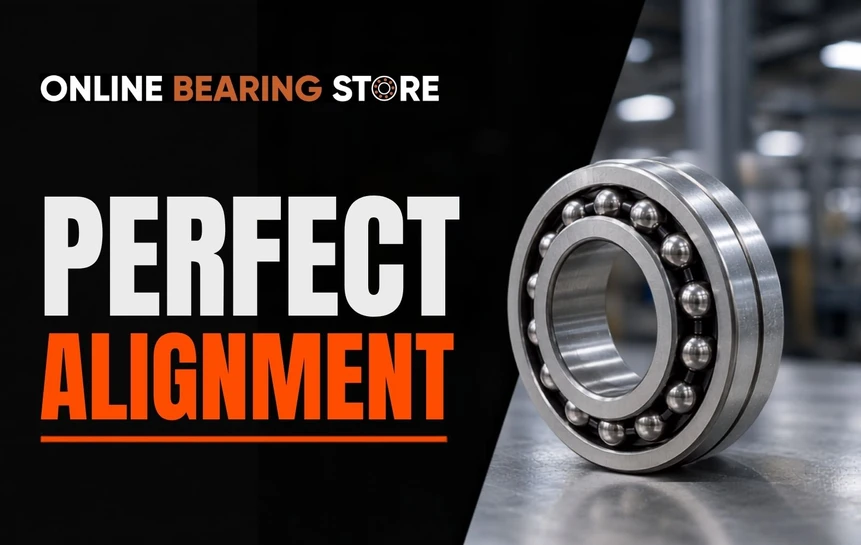
Self-Aligning Ball Bearings: The Right Fix When Shaft Deflection Is the Problem
Shaft deflection is one of those subtle issues that quietly destroys bearings long before most teams realize what’s happening, which is exactly why self-aligning ball bearings were engineered—to keep equipment running smoothly even when the shaft refuses to stay perfectly straight.
What Are Self-Aligning Ball Bearings?
Basic Design and Construction
Self-aligning ball bearings are built around a clever geometry that lets the bearing adjust itself when the shaft bends or shifts. At the core of the design are two rows of balls, forming classic double row self-aligning ball bearings, running inside a common spherical outer raceway, paired with a self centering inner ring assembly that pivots as the shaft moves. This spherical interface is the foundation of self-aligning bearing design, allowing the bearing to compensate for angular misalignment without generating the destructive edge loading that ruins standard ball bearings.
The inner ring, cage, and ball set essentially “float” within the spherical outer ring, maintaining proper rolling contact even when the shaft isn’t perfectly aligned with the housing. This keeps friction low, reduces heat, and prevents premature fatigue, making these bearings a reliable bearing for shaft misalignment in everyday industrial environments.
How They Differ from Standard Ball Bearings
Deep groove ball bearings are excellent for high-speed, low-friction applications, but they have one major limitation: they cannot tolerate angular misalignment. Even slight shaft deflection causes the balls to ride up the raceway shoulders, increasing friction, noise, and wear.
Self-aligning ball bearings solve this by allowing the inner ring to pivot inside the spherical outer ring. Instead of forcing the shaft into perfect alignment, the bearing adapts to the shaft’s movement, protecting the rolling elements and extending service life. This is why they’re frequently chosen for shaft deflection bearings and other shaft misalignment solutions.
Why Does Shaft Deflection Cause Bearing Problems?
Common Causes of Shaft Deflection
Shaft deflection is extremely common in industrial machinery, especially where long spans or variable loads are involved. Typical causes include:
- Long shaft spans that naturally flex under their own weight
- Heavy radial or axial loads that bend the shaft during operation
- Housing misalignment from imperfect mounting surfaces
- Manufacturing tolerances that introduce slight angular offsets
- Thermal expansion that changes shaft geometry as temperatures rise
Even small deflections, fractions of a degree, can create major problems for bearings not designed to handle misalignment, which is why shaft deflection bearings like self-aligning designs are so valuable.
How Misalignment Damages Standard Bearings
When a standard bearing experiences misalignment, the rolling elements no longer distribute load evenly. Instead, they concentrate force on one edge of the raceway, causing:
- Edge loading
- Accelerated wear
- Higher operating temperatures
- Lubrication breakdown
- Premature fatigue failure
This is why misalignment is one of the most common root causes of early bearing failure across industries and why shaft misalignment solutions are essential for reliability.
How Do Self-Aligning Ball Bearings Compensate for Misalignment?
The Spherical Outer Raceway Mechanism
The spherical outer raceway is the key to the bearing’s self-aligning capability. As the shaft bends or shifts, the inner ring and ball set pivot inside the outer ring, maintaining proper rolling contact. This prevents the destructive edge loading that occurs in standard bearings and keeps the bearing running smoothly even when the shaft isn’t perfectly straight.
This mechanism is central to self-aligning bearing design, allowing the bearing to adapt continuously to shaft movement.
Static vs Dynamic Misalignment
Self-aligning ball bearings handle two types of misalignment:
- Static misalignment Installation errors, imperfect housings, or slight angular offsets during assembly. The bearing compensates immediately.
- Dynamic misalignment Ongoing shaft deflection caused by load changes, vibration, or thermal expansion. The bearing continuously adjusts as the shaft moves.
This dual capability is what makes these bearings such a dependable bearing for shaft misalignment in real-world applications.
What Are the Design Features of Self-Aligning Ball Bearings?
Bore Types: Cylindrical vs Tapered
Self-aligning ball bearings are available with:
- Cylindrical bores for direct mounting on standard shafts
- Tapered bores (1:12 or 1:30) for mounting with adapter or withdrawal sleeves
Tapered bores are especially useful for large shafts or applications where precise mounting and easy removal are important.
Cage Materials and Options
Cage materials influence speed, load capacity, and operating temperature. Common options include:
- Pressed steel cages for general-purpose industrial use
- Machined brass cages for higher loads and better stability
- Polymer cages for quieter operation and reduced friction
Sealed and Shielded Variants
In contamination-prone environments, sealed or shielded versions help protect the bearing from dust, moisture, and debris. Sealed bearings also retain lubrication longer, reducing maintenance intervals.
These design choices directly affect self-aligning ball bearing tolerance, especially in demanding environments where spherical self-aligning bearings are preferred.
What Are the Load and Speed Limitations of Self-Aligning Ball Bearings?
Radial and Axial Load Capacity
Self-aligning ball bearings are designed for moderate radial loads and light axial loads. Because balls have point contact rather than line contact (as in roller bearings), they cannot carry the same heavy loads as spherical roller bearings.
However, their ability to operate smoothly under misalignment makes them ideal for applications where shaft deflection is unavoidable. This is why engineers often evaluate self-aligning ball bearing load capacity when selecting bearings for flexible shaft systems.
Speed Ratings
One major advantage of self-aligning ball bearings is their ability to run at relatively high speeds. The ball and raceway geometry minimizes friction, allowing these bearings to outperform spherical roller bearings in speed-critical applications.
Misalignment Tolerance Reference Table
Typical allowable misalignment ranges from 0.5° to 3°, depending on bore size and bearing series.
|
Bearing Series |
Typical Misalignment Tolerance |
|
1200 Series |
2.5° |
|
1300 Series |
2.0° |
|
2200 Series |
1.5° |
|
2300 Series |
1.0° |
These values help engineers determine self-aligning ball bearing tolerance for specific applications.
How Do Self-Aligning Ball Bearings Compare to Spherical Roller Bearings?
Load Capacity Differences
Spherical roller bearings use barrel-shaped rollers that provide line contact, giving them significantly higher load capacity than ball bearings. Self-aligning ball bearings use point contact, which limits load capacity but reduces friction and allows higher speeds.
Cost and Application Trade-offs
Self-aligning ball bearings are typically:
- More economical
- Better for high-speed applications
- Ideal for light-to-moderate loads
- Perfect for equipment where misalignment is unavoidable but loads aren’t extreme
Comparison Table
|
Feature |
Self-Aligning Ball Bearings |
Spherical Roller Bearings |
Standard Ball Bearings |
|
Misalignment Tolerance |
High |
Very High |
Very Low |
|
Load Capacity |
Moderate |
High |
Moderate |
|
Speed Capability |
High |
Moderate |
High |
|
Cost |
Low |
Higher |
Low |
|
Best Use Case |
Shaft deflection, moderate loads |
Heavy loads, severe misalignment |
Precision alignment, high speed |
This comparison highlights the practical differences in self-aligning bearings vs spherical roller bearings and helps engineers choose the right option.
What Are Common Applications for Self-Aligning Ball Bearings?
Conveyor and Material Handling Systems
Long shaft runs in conveyors often flex under load, making self-aligning ball bearings ideal for pulleys, rollers, and drive assemblies. These are classic self-aligning ball bearing applications.
Agricultural and Textile Machinery
These machines frequently use shafts supported at multiple points, often with imperfect alignment. Self-aligning bearings help maintain smooth operation despite these inconsistencies.
Fans, Blowers, and Light Industrial Equipment
Moderate loads combined with shaft flexing make these applications perfect candidates for spherical self-aligning bearings and other misalignment-tolerant designs.
How Do You Select and Install Self-Aligning Ball Bearings Correctly?
Matching Bearing Size to Shaft and Housing
Selection should consider:
- Bore type (cylindrical or tapered)
- Expected misalignment angle
- Radial and axial load direction
- Housing geometry
- Operating speed
These factors ensure the bearing meets the required self-aligning ball bearing tolerance and performance expectations.
Installation Best Practices
Key guidelines include:
- Using adapter sleeves for tapered bores
- Avoiding forced alignment that defeats the bearing’s purpose
- Ensuring proper lubrication during assembly
- Verifying free movement of the inner ring after mounting
Maintenance Considerations
Self-aligning ball bearings require:
- Regular lubrication checks
- Periodic inspection for noise or vibration
- Monitoring for contamination in harsh environments
These steps help maintain the bearing’s ability to act as a reliable bearing for shaft misalignment.
Where Can You Find Self-Aligning Ball Bearings from Online Bearing Store?
Self-Aligning Ball Bearing Product Range
Online Bearing Store offers:
- Multiple bore sizes
- Cylindrical and tapered options
- Sealed and shielded variants
- Adapter sleeves and mounting accessories
Technical Support for Bearing Selection
Their team provides guidance on:
- Matching bearings to misalignment conditions
- Selecting cage materials
- Choosing the right bore type
- Troubleshooting premature failure
Solve Shaft Deflection Issues with the Right Bearing
Shop Online Bearing Store’s full range of self-aligning ball bearings or contact their technical team for help selecting the right bearing for your application.
FAQ (10 Expanded Questions)
1. What makes self-aligning ball bearings different from standard ball bearings? Their spherical outer raceway allows the inner ring to pivot and compensate for misalignment.
2. How much misalignment can these bearings typically handle? Most tolerate between 0.5° and 3°, depending on series and bore size.
3. Are self-aligning ball bearings suitable for heavy loads? They’re best for moderate loads; spherical roller bearings are better for heavy-duty applications.
4. Can they handle axial loads? Yes, but only light axial loads due to ball contact geometry.
5. Do sealed versions reduce maintenance? Absolutely sealed bearings retain lubrication longer and block contaminants.
6. Are tapered bore bearings harder to install? Not at all; adapter sleeves make installation straightforward and precise.
7. Can these bearings operate at high speeds? Yes, they’re excellent for high-speed applications thanks to low friction.
8. What industries use self-aligning ball bearings most? Material handling, agriculture, textiles, HVAC, and general industrial machinery.
9. How do I know if shaft deflection is causing bearing failure? Look for uneven wear, elevated temperatures, vibration, or repeated premature failures.
10. Where can I buy self-aligning ball bearings? Online Bearing Store offers a wide selection plus technical guidance for choosing the right model.