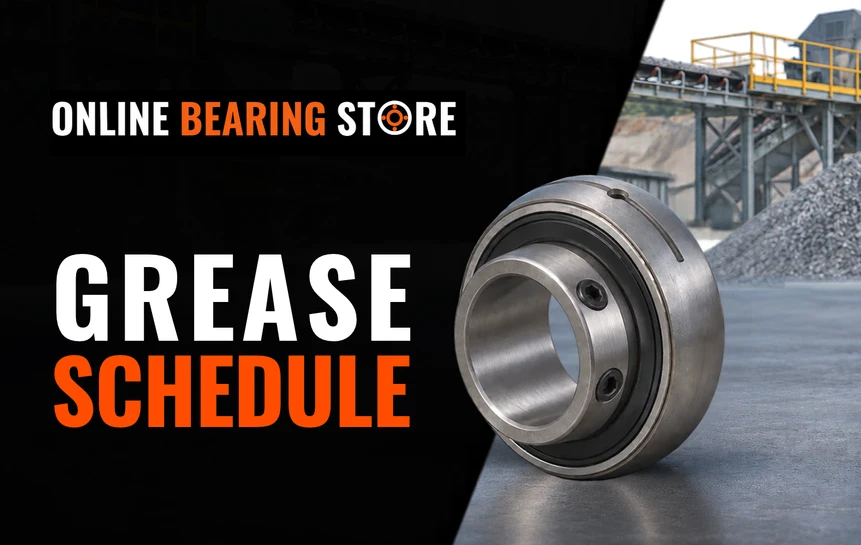
Insert Bearing Grease Intervals in Conveyors: How Often Is Often Enough?
A tail pulley bearing on a gravel conveyor can seize halfway through a shift even when the crew has greased it every Friday for years, because a recent speed increase and contamination at the seal changed the conditions the old schedule was built around.
Why Do Grease Intervals Matter So Much for Conveyor Insert Bearings?
There is no single grease interval that suits every conveyor. In clean, moderate-temperature service, many relubricable insert bearings can start with a one to three month interval, then be adjusted for speed, heat, operating hours and contamination. Setting suitable insert bearing grease intervals helps you protect the bearing without adding grease more often than necessary.
How Insert Bearings Lose Grease in Conveyor Service
Grease does not last forever. Heat gradually oxidizes it and reduces its ability to protect the rolling elements and raceways. Dust, grit and moisture can also work past the seals, while normal operation can push grease out through the seal or flinger.
Conveyor conditions make this process less predictable. A bearing beside a dusty transfer point may need attention sooner than one in a clean, sheltered area. Effective conveyor bearing lubrication means matching the grease type, amount and timing to the actual operating environment.
What Happens When Intervals Are Too Long
When you wait too long between relubrication, the grease film can break down. The bearing may run hot, develop rough raceways or allow contaminants to cause abrasive wear. If the damage continues, the bearing can seize and stop the conveyor.
These are important signs of conveyor bearing failure to watch for, particularly when noise, vibration or temperature begins to rise.
What Happens When Intervals Are Too Short
More grease does not automatically mean more protection. Adding grease too frequently or in excessive quantities can cause churning, which creates heat and increases pressure inside the housing. That pressure can damage seals and force grease out where it attracts dirt.
Avoiding over-greasing pillow block bearings is just as important as preventing them from running short of lubricant.
What Factors Determine How Often You Should Grease Conveyor Bearings?
Your interval should reflect how fast the bearing runs, how long the conveyor operates, how hot the housing gets, and how much contamination reaches the seals. These factors work together. A bearing running at moderate speed may still need frequent attention if it is exposed to water spray or abrasive dust.
Speed and Duty Cycle
Higher shaft speeds generally shorten grease life. Longer daily operating hours also mean the bearing accumulates running time faster. A conveyor running around the clock may need about half to a third of the table interval.
When deciding how often to grease conveyor bearings, calculate the schedule around actual operating hours rather than simply choosing a day of the week.
Operating Temperature
Grease life drops sharply as operating temperature rises, particularly above about 160°F (70°C). Bearings near dryers, ovens, kilns or hot process equipment may need shorter intervals and a grease rated for the application.
Always check the grease and bearing manufacturer's temperature limits. Temperatures above 200°F (95°C) require particular care and may call for a different lubricant or bearing arrangement.
Contamination and Moisture
Dust, fines and water are common reasons to shorten a relubrication interval. Material can collect around a seal, while washdown spray or rain can introduce moisture. In these conditions, frequent, measured relubrication may help move contaminants toward the seal purge path.
Good conveyor bearing lubrication also depends on keeping grease fittings clean and preventing dirt from entering during service.
Load and Bearing Position on the Conveyor
Not every pulley bearing experiences the same load or exposure. Belt tension, drive torque, carryback and spillage all affect operating conditions. Use the table as a practical comparison when setting your pillow block bearing grease frequency.
|
Conveyor position |
Typical load |
Typical exposure |
Interval guidance |
|
Drive or head pulley |
Highest, due to belt tension and drive torque |
Spillage near discharge |
Shortest interval on the conveyor |
|
Tail pulley |
Moderate to high |
Carryback and spillage near loading zone |
Short interval; often the dirtiest position |
|
Take-up pulley |
Moderate |
Often low and difficult to reach |
Standard interval; consider remote lines or automatic lubrication |
|
Snub or bend pulley |
Low to moderate |
Varies by location |
Standard to extended interval |
The table is a starting point, not a substitute for inspection. Conveyor pulley bearing lubrication should reflect the conditions at each pulley, not a single schedule applied across the whole system.
Seal Type and Insert Design
Some insert bearings use contact seals, while others combine flingers with sealing features to help keep contaminants out. Their ability to retain grease and resist contamination varies.
Check whether the insert has a grease fitting and is designed for relubrication. A sealed-for-life insert is not intended to receive additional grease. Applying grease to a bearing that cannot be relubricated may damage the seal or serve no useful purpose.
What Is a Good Baseline Grease Interval for Conveyor Insert Bearings?
For clean, moderate-temperature service, one to three months is a reasonable starting point for many relubricable conveyor insert bearings. Heavier contamination, higher temperatures, faster speeds and longer operating hours can shorten that interval considerably. Use the table below to establish a starting conveyor bearing maintenance schedule, then confirm it against the bearing manufacturer's catalog.
Baseline Interval Reference Table
The following ranges assume 8 to 16 operating hours per day and a relubricable ball insert using NLGI 2 grease. They are typical starting points, not guaranteed service intervals.
|
Operating environment |
Temperature |
Up to 50% of rated speed |
50% to 100% of rated speed |
|
Clean and dry |
Up to 120°F (50°C) |
3 to 6 months |
1 to 3 months |
|
Light dust, moderate humidity |
120 to 160°F (50 to 70°C) |
1 to 3 months |
2 to 4 weeks |
|
Heavy dust or dirt |
160 to 200°F (70 to 95°C) |
1 to 4 weeks |
About 1 week |
|
Very heavy contamination, water spray or extreme heat |
Above 200°F (95°C) |
Daily to weekly |
Daily |
Use these values to begin planning the relubrication interval for insert bearings, not as a replacement for manufacturer guidance. Confirm the bearing type, grease, speed, and temperature limits before adopting a schedule.
Adjusting for 24/7 Operation and Seasonal Changes
For continuous operation, consider starting with about half to a third of the table interval. Reassess during wet seasons, periods of heavy washdown and summer heat. These conditions can increase contamination or temperature and may require more frequent checks.
Record changes rather than adjusting the entire conveyor automatically. Some bearing positions may need a shorter interval while others can remain on their existing schedule.
Manufacturer Guidance vs. Plant Experience
Start with the bearing manufacturer's lubrication recommendations. Then compare them with what you see during inspections. Record temperature, noise, grease condition and any signs of contamination.
If a bearing repeatedly shows dark or dry grease before its scheduled service, shorten the interval and monitor the result. If it consistently shows excessive purge or rising temperature after greasing, review the quantity and timing. Your maintenance records should gradually make the conveyor bearing maintenance schedule more accurate.
How Much Grease Should You Add Each Time?
The right quantity depends on the bearing's size and design, the available free space inside the housing and the manufacturer's instructions. A useful calculation can provide an initial estimate, but do not treat it as a universal dose. Understanding how much grease in a pillow block bearing is appropriate helps prevent both lubricant starvation and excess grease.
Estimating the Replenishment Quantity
A common rule of thumb for estimating grease quantity is:
G = 0.045 × D × B
Where:
- G = grease quantity in ounces
- D = bearing outside diameter in inches
- B = bearing width in inches
The metric equivalent is:
G = 0.002 × D × B
Where G is in grams, and D and B are in millimeters.
For example, a bearing with a 4 inch outside diameter and a 1 inch width gives an estimated quantity of about 0.18 ounces. Treat this as a planning estimate only. Follow the bearing manufacturer's specified quantity whenever it is available.
Calibrating Your Grease Gun
Grease guns do not all deliver the same amount per stroke. To find the output, weigh a container, apply 10 full strokes and weigh it again. Divide the difference by 10 to calculate the average amount delivered per stroke.
You can then convert the target grease quantity into a stroke count. Recheck the output if you change grease guns or cartridges. This simple step makes your pillow block bearing grease frequency plan more repeatable because each service delivers a known amount.
Reading the Purge at the Seal
On many relubricable inserts, a slight bead of fresh grease at the seal can indicate that enough grease has passed through the bearing. Stop at the manufacturer's recommended quantity or purge condition.
Do not keep pumping simply to produce a large bead. Continuous purging can indicate excess grease, and forcing grease past a seal can damage it. Never use this method on sealed-for-life bearings.
How Do You Re-Grease a Conveyor Insert Bearing Correctly?
A consistent method helps prevent contamination and makes each service easier to document. Before you start, confirm that the bearing is designed for relubrication and that the grease is suitable. Safe conveyor pulley bearing lubrication begins with proper access and isolation.
Lock Out the Conveyor and Plan Access
1. Follow your site's lockout/tagout procedure and verify that the conveyor cannot start
unexpectedly.
2. Plan safe access to the bearing and grease fitting. Never reach through or into guarding
while a conveyor is running.
3. If the application requires lubrication while equipment is operating, use properly installed
remote grease lines routed outside the guards and follow the equipment manufacturer's and site's approved procedure.
Manual shaft rotation is not required for every bearing application. Follow the bearing manufacturer's instructions and your site's safe work procedure.
Clean the Fitting and Confirm the Grease
Wipe dirt and old grease from the fitting before attaching the grease gun. Clean the gun coupler as well. Confirm the grease type already in the bearing and check compatibility before changing products. Mixing incompatible greases can cause softening, hardening, or reduced performance.
Pump Slowly and Watch the Seal
Apply the calculated amount slowly. Avoid forcing grease into the housing with rapid strokes. Where the manufacturer's procedure calls for rotation, follow its instructions and only use an approved method under the required safety controls.
Watch for the specified purge condition, if the bearing design allows it. Stop when you reach the recommended quantity or stopping point. This measured approach helps reduce over-greasing pillow block bearings.
Record the Relube
Log the date, bearing location, grease type, quantity and any observations. Include unusual noise, heat, contamination, or seal damage. These records help you identify patterns and refine the relubrication interval for insert bearings over time.
How Can You Tell If Your Grease Interval Is Wrong?
Your bearing often gives warning signs before it fails. Compare its condition before and after each service and look for changes that repeat. Recognizing signs of conveyor bearing failure early can help you correct the lubrication plan before a breakdown stops production.
Signs You Are Greasing Too Seldom
Watch for rising operating temperature, unusual noise, rough rotation, dark or dry grease near the seal and increasing vibration. These symptoms can indicate lubricant breakdown or contamination, although they may also point to alignment, load, or bearing damage.
Signs You Are Greasing Too Often
Heavy grease purge, buildup around the housing, damaged seals and temperature spikes soon after servicing can indicate excessive grease or an unsuitable procedure. Review the amount delivered per stroke and the quantity applied at each service.
|
Too seldom |
Too often |
|
Dry or dark grease |
Heavy grease purge |
|
Rising noise or vibration |
Grease buildup around housing |
|
Temperature gradually increases |
Temperature spikes after greasing |
|
Rough operation |
Seal damage or leakage |
Using Temperature and Vibration to Fine-Tune
Use an infrared thermometer or contact temperature probe to track bearing housing temperatures at consistent locations. A handheld vibration meter can help identify changes in bearing condition. Record readings under similar operating conditions so you can compare them over time.
Weekly conveyor bearing walk-down checklist
- Check and record bearing temperature.
- Listen for unusual noise.
- Inspect grease condition and seal areas.
- Check set screws or locking collars for tightness.
- Check housing bolts for looseness.
- Note visible contamination, water ingress or grease buildup.
- Record any changes and schedule follow-up inspection.
This routine supports a more reliable conveyor bearing maintenance schedule and helps you act on developing problems instead of waiting for a failure.
When Should You Switch to Automatic Lubrication or Sealed-for-Life Inserts?
Manual greasing is not always the most practical approach. Hard-to-reach bearings, frequent contamination and large numbers of lubrication points can make a manual schedule difficult to maintain. In these cases, automatic lubricators for conveyors or sealed-for-life inserts may be worth considering.
Single-Point Automatic Lubricators
Single-point units deliver measured amounts of grease over a set period. They can be useful for difficult-to-reach positions, including tail and take-up pulleys, where regular manual access is inconvenient. Correct sizing and setting matter. The delivery rate must suit the bearing and operating conditions.
Centralized Lubrication for Long Conveyors
Long conveyors with many bearing points may benefit from a centralized system. It can supply several lubrication points from one system and reduce the need for repeated manual rounds. Consider the number of bearings, line layout, maintenance access and service requirements before choosing a system.
Sealed-for-Life Insert Bearings
Sealed-for-life inserts can suit clean environments, lighter loads or locations where routine relubrication is impractical. They are designed to operate without additional grease during their intended service life. Do not add grease unless the manufacturer specifically allows it.
What Does Online Bearing Store Offer for Conveyor Bearing Lubrication?
Choosing the right components and lubricant helps you build a practical maintenance plan. Online Bearing Store offers insert bearings and housed units for conveyor applications.
Insert Bearings and Housed Units
Explore relubricable and sealed-for-life insert bearings, along with pillow block and flange units for different mounting arrangements. Select a unit based on shaft size, load, speed, environment, and lubrication requirements.
Technical Support for Interval Planning
If you are reviewing your conveyor bearing maintenance schedule, contact us for help considering bearing selection, grease requirements and operating conditions when planning an interval.
What Are Common Questions About Conveyor Bearing Grease Intervals?
1. Can you grease a conveyor bearing while it is running?
Never reach into guarding or approach an exposed rotating shaft to grease a bearing. Follow lockout/tagout and your site's safety procedures. If lubrication during operation is required by the approved application procedure, use remote grease lines routed outside the guards.
2. Do sealed insert bearings ever need grease?
Sealed-for-life insert bearings are designed to operate without routine relubrication. Do not add grease unless the manufacturer specifically states that the bearing can be serviced.
3. Is it safe to mix different greases in a pillow block bearing?
Not without checking compatibility. Different thickener types and additive packages may react and affect grease consistency or performance. Confirm compatibility with the lubricant supplier or bearing manufacturer before changing grease.
4. How do I know if a pillow block bearing is relubricable?
Look for a grease fitting and check the bearing's model information or manufacturer catalog. Some housings may have fittings even when the installed insert is not designed for relubrication, so confirm the insert itself.
5. How often should you grease conveyor bearings?
For many relubricable inserts in clean, moderate-temperature service, one to three months is a reasonable starting point. Shorten the interval for high speed, continuous operation, heat, dust or moisture, and confirm the schedule against manufacturer guidance.
6. Can you use NLGI 2 grease in conveyor insert bearings?
NLGI 2 grease is common in many insert bearing applications, but it is not suitable for every bearing or operating condition. Check the manufacturer's recommendations for grease type, base oil viscosity, temperature range and compatibility.
7. What happens if you over-grease a pillow block bearing?
Excess grease can churn inside the housing, create heat, increase pressure and damage seals. It can also force grease out around the seal and attract contamination. Use a measured quantity and follow the manufacturer's instructions.
8. Should you use the same grease interval for every conveyor bearing?
No. Drive, head, tail, take-up, snub and bend pulley bearings can have different loads, temperatures and contamination levels. Set intervals by bearing position and operating conditions rather than applying one schedule to every point.
9. What is the best way to check conveyor bearing temperature?
Use an infrared thermometer or contact temperature probe and measure at consistent locations under similar operating conditions. Record readings over time. A rising trend can signal a lubrication issue or another developing mechanical problem.
10. When should you replace a conveyor insert bearing instead of re-greasing it?
Replace the bearing if it has severe noise, rough rotation, persistent overheating, visible damage or evidence of advanced wear. Grease cannot repair damaged raceways or rolling elements. Identify and correct the cause of failure before installing the replacement.
Ready to Put Your Conveyor Grease Schedule on Solid Ground?
A reliable grease plan starts with the right bearing, the right quantity and an interval that reflects real operating conditions. Shop insert bearings and housed units at Online Bearing Store, or contact us for help planning a schedule for your conveyor.