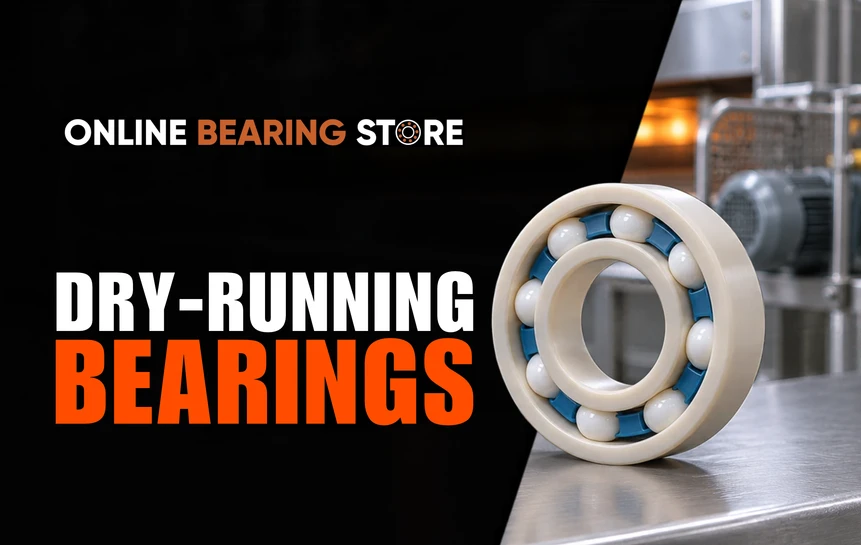
Dry-Running Food Grade Bearings: When Lubricant-Free Operation Is a Requirement
Picture this: your bakery oven conveyor is running mid-shift when standard bearing grease bakes, carbonizes, and drips black spots onto fresh product. The batch is rejected and the line stops. Dry-running food grade bearings reduce this risk because they run without added grease or oil. Instead, they rely on self-lubricating polymers, PTFE transfer films, or low-friction ceramics. In this guide, you will learn when your process calls for lubricant-free bearings, how the main materials perform, where the trade-offs lie, and how to choose the right conveyor bearings for your plant.
What Are Dry-Running Food Grade Bearings?
Standard industrial bearings rely on a film of grease or oil to keep rolling elements apart from the metal races. Dry-running bearings for sanitary applications are built to work with no added liquid lubricant, which reduces the risk of grease purging, dripping, or washing into your product stream.
A bearing is considered food grade when its materials comply with FDA regulations for food contact (21 CFR) and the manufacturer provides a compliance statement for it.
How Bearings Run Without Grease or Oil
Dry-running bearings use one of three material mechanisms:
- Self-lubricating polymers: Resins such as acetal, PEEK, and UHMW-PE are blended with solid lubricant additives. As the bearing turns, these additives coat the contact path and lower friction.
- PTFE transfer films: In PTFE-lined bushings, sliding motion deposits a thin layer of fluoropolymer onto the shaft, creating a low-friction polymer-on-polymer surface.
- Low-friction ceramic contact: Silicon nitride (Si3N4) and zirconia (ZrO2) are dense, hard, and smooth. They roll against mating races with little risk of galling or scuffing.
Dry-Running vs Sealed-for-Life Bearings
It is easy to confuse dry-running bearings with sealed-for-life steel bearings. Sealed bearings are factory-packed with grease behind rubber seals. Over time, hot high-pressure washdowns, sanitizers, or heat can break down those seals, letting grease out and water in. Oil-free bearings for food processing contain no grease or oil from the factory, so there is no lubricant to leak, wash away, or reach your product.
When Is Lubricant-Free Operation a Requirement?
Grease-lubricated stainless bearings work well in many transfer areas. But some food plant environments make wet lubricants a real liability, and in those spots a self-lubricating bearing is often the safer choice.
Direct or Overhead Product Exposure
Whenever a bearing sits above, beside, or inside an open product zone (dough sheeters, filling stations, overhead cooling conveyors), any lubricant purge becomes a food safety issue. Plastic bearings help prevent oil drops from ruining batches and forcing line shutdowns.
Aggressive Washdown and Sanitation Cycles
Daily sanitation uses hot water, caustics, and acid foams. High-pressure washdowns can strip grease from standard bearings and push water inside. A bearing with no grease to lose helps avoid emulsified grease pockets where bacteria can grow.
Extreme Temperatures in Ovens and Freezers
Liquid grease has clear thermal limits:
- Ovens, proofers, and fryers: Standard greases thin out, smoke, and bake into hard carbon deposits. High-temperature dry bearings help prevent this buildup and the shaft lock-up it can cause.
- Spiral freezers and cold storage: Base oils thicken, which raises drag, loads drive motors, and shortens conveyor bearing life.
Allergen Control and Customer Audit Requirements
Quality standards and retail customer audits keep tightening rules on lubricants near exposed food. Non-lubricated bearings in these zones reduce lubricant contamination risk and can simplify audits and HACCP documentation.
Is Lubricant-Free Required? Printable Assessment Checklist
Use this checklist during equipment design, line retrofits, or plant audits to decide whether a bearing position should go lubricant-free.
Food Line Bearing Assessment Checklist
☐ Direct product exposure: Is the bearing mounted over or next to open, unpackaged food?
☐ Heavy washdown: Does the area get daily high-pressure, hot-water, or caustic washdown?
☐ Temperature extremes: Does the operating temperature drop below -20°F or go above 250°F?
☐ Contamination impact: Would a single drip of oil or grease mean a product rejection or recall?
☐ Maintenance access: Is the bearing hard to reach, in a hazardous spot, or difficult to grease?
If you checked two or more boxes, a lubricant-free bearing is strongly recommended.
Which Materials Are Used in Dry-Running Bearings?
Choosing among dry-running bearing materials means matching the polymer or ceramic to your load, temperature, and chemical exposure.
Polymer Bearings (Acetal, PEEK, UHMW-PE)
Polymer bearings are lightweight, quiet, and corrosion-resistant:
- Acetal (POM): Stable, with low moisture absorption. A good fit for standard conveyors, sorters, and container handling. It has limited resistance to chlorine sanitizers and strong acids.
- UHMW-PE: High impact strength and low friction. Works well in wet, abrasive washdown areas and freezer guides.
- PEEK: A high-performance polymer rated for continuous service up to about 480°F (250°C), with good resistance to most acid and alkaline cleaners.
PTFE-Based Self-Lubricating Bearings
PTFE has one of the lowest friction coefficients of any solid engineering material. It is usually made into sleeve bushings, flanged liners, or thrust washers. It performs well under slow oscillating or sliding loads, where grease would squeeze out.
Full Ceramic Bearings
Full ceramic bearings use zirconia (ZrO2) or silicon nitride (Si3N4) for both races and rolling elements, so they do not rust. Their temperature rating depends on the ceramic and the cage. The cage (often PEEK or PTFE, about 480°F) usually sets the limit, so check the manufacturer's data sheet. With a suitably rated cage, they suit high-heat oven duty.
Hybrid Polymer and Stainless Constructions
Polymer-ring ball bearings with 316 stainless or glass balls offer smooth rotation and strong washdown corrosion resistance at a lower price than full ceramic designs. They suit high-moisture sorting tables and washdown conveyors.
Material Comparison Table
|
Material |
Temp (°F) |
Load |
Speed |
Chemical resistance |
Best for |
|
Acetal (POM) |
-40 to 180 |
Moderate |
Moderate |
Good in water; limited with chlorine and strong acids |
Conveyors, rinsers, pack-off tables |
|
UHMW-PE |
-100 to 180 |
Low–moderate |
Low |
Very good with most caustics |
Freezer guides, washdown sorters |
|
PEEK |
-40 to 480 |
Moderate–high |
Moderate |
Resists most acids and alkalis |
Ovens, fryers, steam cookers |
|
PTFE composite |
-320 to 500 |
High (static/linear) |
Low |
Inert to most cleaners |
Pivots, linkages, slow sleeves |
|
Full ceramic (ZrO2/Si3N4) |
Set by ceramic and cage; see data sheet |
Moderate–high |
High |
Highly resistant to acids and salt water |
High-heat baking, dip tanks |
|
Hybrid polymer/stainless |
Depends on the polymer |
Moderate |
Moderate |
Good; cage dependent |
Bottling, tray sorters, washdown conveyors |
Note: Values are general material guidance, not ratings. Always check load, speed, and temperature limits on the manufacturer's data sheet before you specify.
What Are the Trade-Offs of Running Without Lubricant?
Dry-running bearings behave differently from greased steel bearings. Knowing their limits helps you avoid unexpected wear.
Lower Load and Speed Limits
Without grease to carry heat away, polymer and other dry bearings work within a pressure-velocity (PV) limit:
PV = pressure (psi) x surface speed (ft/min)
If your application goes over a material's PV limit, friction heat builds quickly. That heat can soften the polymer or speed up surface wear. For this reason, plastic bearings generally carry lower load and speed ratings than comparable greased steel bearings.
Thermal Expansion and Fit Considerations
Polymers expand much more than stainless shafts as temperature rises. As a plastic bearing warms up, its bore can tighten on the shaft. Allow for the higher expansion rate and specify more internal radial clearance to avoid binding.
Wear Life and Replacement Planning
Self-lubricating bearings wear very gradually as they renew their transfer film, so they have a finite service life. Rather than failing suddenly through spalling like fatigued steel bearings, they usually show a slow, steady increase in clearance. Scheduled inspections let you plan replacements ahead of time.
Where Do Dry-Running Bearings Work Best in Food Processing?
Matching each processing zone to the right material helps extend service life across your conveyor bearings.
Oven, Proofer, and Fryer Conveyors
Baking, proofing, and frying expose bearings to heat that quickly carbonizes grease. PEEK polymer bearings, and ceramic bearings with a cage rated for the temperature, can run in these zones without smoking or carbon buildup.
Freezer Tunnels and Cold Storage Conveyors
Spiral freezers and freezer tunnels stiffen standard grease and add drag on conveyor drives. UHMW-PE and PTFE composite bearings stay slick at sub-zero temperatures and help keep start-up torque low.
Product-Contact Conveyors, Slicers, and Filling Lines
Where equipment sits over uncovered food, such as packaging and slicer feeds, hybrid polymer and acetal bearings remove the grease that could drip onto product. That helps support your food safety program.
Application Matching Table
|
Processing zone |
Operating challenges |
Recommended bearing |
Key benefit |
|
Ovens, proofers & fryers |
Heat up to 450°F, grease carbonization |
PEEK polymer, or full ceramic (Si3N4) with a suitably rated cage |
No grease to smoke or carbonize |
|
Freezers & cold storage |
Temperatures down to -40°F, frost, stiff grease |
UHMW-PE or PTFE composites |
No grease to stiffen; easier motor start-up |
|
Product-contact lines |
Overhead mounting, open food, strict audits |
Acetal (POM) or hybrid stainless |
No grease to drip onto exposed product |
|
Washdown & CIP areas |
High-pressure water, caustics, acid foam |
Hybrid glass/polymer or UHMW-PE |
Won't rust; check resistance to your sanitizers |
|
Filling & capping |
Splashing liquids, powder buildup |
PTFE-lined sleeves or PEEK ball bearings |
Powders less likely to stick to dry surfaces |
How Do You Specify a Dry-Running Bearing for Your Application?
Moving a line from greased steel to dry-running bearings is straightforward if you work through these steps.
Step-by-Step Specification Sequence
- Gather real operating data: Record actual radial load, working RPM, continuous operating temperature, and peak washdown temperature rather than relying on nameplate estimates.
- Calculate system PV: Multiply bearing pressure by surface speed and confirm the result falls within the material's allowable PV range.
- Cross-check cleaning chemicals: Compare your sanitation chemicals and their concentrations (caustics, acids, chlorine) against the manufacturer's chemical resistance charts.
- Inspect shaft surface finish: Sleeve bearings need a smooth shaft, ideally 8 to 16 µin Ra. A rough shaft acts like sandpaper and speeds up sleeve wear.
- Verify fits and clearances: Choose wider internal radial clearance for polymer bearings to allow for thermal expansion, and confirm housing tolerances with the manufacturer's fit tables before machining mounts.
For a quick decision path: first, check for open product exposure; if present, specify a lubricant-free bearing. Second, assess washdown intensity to decide whether you need polymer or hybrid construction. Third, look at temperature: UHMW-PE for freezing conditions, acetal for ambient lines, and PEEK or ceramic for high-heat ovens. Finally, check load and speed against the material's PV limit.
Why Choose Online Bearing Store for Lubricant-Free Food Processing Bearings?
Online Bearing Store offers bearing options for food production, packaging, and bottling lines, along with help choosing the right material.
Polymer, Ceramic, and Stainless Bearing Options
Browse our range of acetal, UHMW-PE, PEEK, full ceramic, and hybrid stainless bearings in our food-grade bearings collection. Contact us for availability on specific sizes and materials.
Technical Support for Application Review
Not sure whether PEEK, UHMW-PE, or full ceramic suits your line? Contact our technical team with your load, speed, temperature, and washdown details, and we can help you narrow the options.
Frequently Asked Questions
1. Can dry-running bearings handle high-pressure chemical washdowns?
In most cases, yes. Engineering plastics such as acetal, UHMW-PE, and PEEK, as well as ceramics, do not rust in water. With no grease inside, high-pressure water and caustic sprays have no lubricant to flush out. Note that acetal has limited resistance to chlorine sanitizers and strong acids, so check your chemicals against the data sheet.
2. Do polymer ball bearings wear out faster than steel bearings?
In light-to-medium load applications, polymer ball bearings can outlast steel bearings in wet areas, because they cannot rust or fail from grease loss. Under higher loads and speeds, they wear gradually as they build their transfer film, so plan regular inspections.
3. Will ceramic bearings shatter under normal conveyor vibration?
Not under normal conditions, but ceramics are brittle. Zirconia (ZrO2) and silicon nitride (Si3N4) bearings handle normal conveyor vibration; avoid impact loads and hammer installation.
4. Do I need special shafts for dry-running sleeve bearings?
For sleeve and bushing applications, a smooth, corrosion-resistant shaft (such as 303, 304, or 316 stainless with an 8 to 16 µin Ra finish) is recommended to limit wear. For mounted polymer ball bearings with an inner race, standard ground stainless shafting is usually suitable.
5. What happens if plastic bearings exceed their temperature limit?
The material softens, loses strength, and wears quickly. In high-heat areas such as ovens, specify PEEK or full ceramic bearings rated for the operating temperature.
6. Are non-lubricated bearings noisier than greased bearings?
Usually not. Polymer and hybrid designs damp vibration well, and many run quieter than steel bearings, especially on long washdown conveyors or empty container lines. Results depend on the design and load.
7. Can food particles damage self-lubricating bearings?
Dry surfaces give powders, flour, and small food particles less to cling to than sticky grease, so they are less likely to form an abrasive paste. Regular cleaning still matters.
8. How do I know when bearings without grease need replacement?
They usually wear gradually rather than failing suddenly. During routine checks you will notice a slow increase in shaft play or clearance, which gives you time to schedule a swap.
9. Are dry-running food grade bearings more expensive than standard steel bearings?
Materials such as PEEK or full ceramic cost more up front. Over time, dry-running bearings can lower total cost by cutting regreasing labor, reducing contamination risk, and reducing downtime from washdown corrosion.
10. Can I add grease to dry-running bearings?
You can add grease to some polymer units, but it is rarely recommended. Grease attracts dirt and grit, can turn into an abrasive sludge, and gives up the main advantage of a dry-running bearing.
Ready to Go Lubricant-Free on Your Food Processing Line?
Cut the risk of grease drips, washdown rust, and oven bearing lock-ups. Browse our food-grade bearings at Online Bearing Store, or contact our technical team for availability and an application review.