
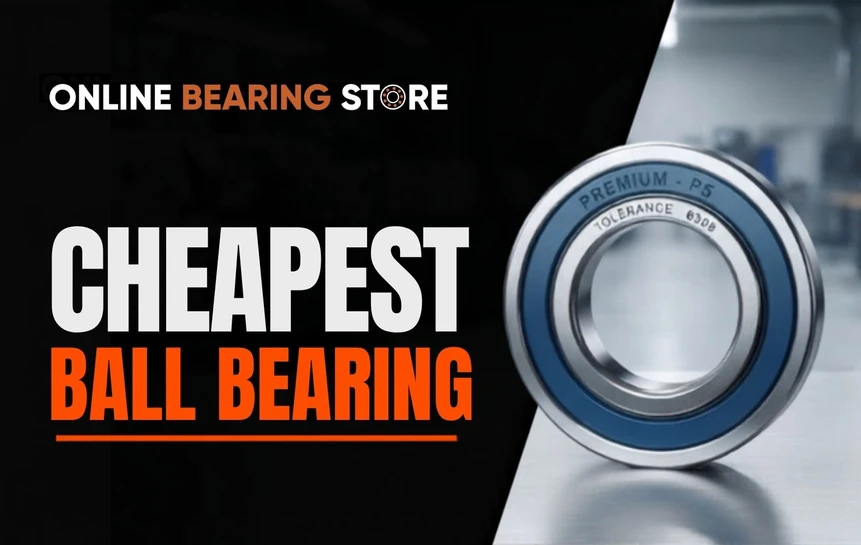
Why Buying the Cheapest Ball Bearings Costs More Over the Equipment Lifecycle
Choosing the lowest priced ball bearing may seem like a smart way to cut costs, but that decision can become expensive once maintenance, downtime, and lost productivity are factored in. Looking at the total cost of ownership (TCO) for bearings, rather than the purchase price alone, leads to buying decisions that improve reliability and reduce long-term operating costs.
What Is Total Cost of Ownership for a Bearing?
Bearing TCO measures what a bearing really costs over its entire service life. Instead of focusing only on the checkout price, it accounts for every expense that follows installation: maintenance, energy consumption, labor, downtime, and replacement costs.
Whether you purchase bearings, manage plant maintenance, or design OEM equipment, understanding TCO helps you choose products that deliver better value over time and lower overall procurement cost.
Beyond the Sticker Price
The purchase price is only a small portion of a bearing's total expense. Saving $20 during procurement might look like a win, but if that bearing fails early and shuts down a production line, repair costs, lost production, and emergency labor can easily exceed hundreds or thousands of dollars.
Looking beyond the sticker price means asking:
- How long is the bearing expected to last?
- How often will it need maintenance?
- Will it reduce or increase downtime?
- How much will replacement cost over the equipment's life?
- Could a failure damage other machine components?
The Hidden Cost Categories
Many of the biggest bearing expenses are hidden because they surface months or years after purchase, including:
- Planned and unplanned maintenance
- Equipment downtime
- Emergency replacement labor and overnight freight
- Increased energy consumption and lubrication costs
- Production delays
- Damage to shafts, housings, gears, or seals
- Additional inspections, troubleshooting, disposal, and recycling
For facilities running around the clock, even a short stoppage can cost far more than the price gap between a budget bearing and a premium one.
Why Procurement Metrics Often Miss TCO
Procurement teams are often rewarded for lowering purchase prices, while maintenance teams are measured on reliability and uptime, a conflict that can drive up total costs. A lower unit price may look good on a purchasing report, but if it means more frequent replacements, overall operating costs rise.
Successful organizations weigh:
- Expected service life
- Maintenance frequency and downtime risk
- Reliability history
- Cost per operating hour
- Overall lifecycle value
When procurement and maintenance teams collaborate, they can choose bearings that support both budget and performance goals.
Why Do Cheap Bearings Fail More Often?
Not every affordable bearing is poorly made, but lower cost products often achieve their price through lower grade materials, less precise machining, weaker seals, or inconsistent quality control. These shortcomings usually aren't visible at installation but emerge after months of use.
Inferior raw materials and metallurgy. Bearing lifespan depends heavily on steel quality. Premium bearings use carefully controlled, consistently heat treated bearing grade steel that improves hardness and fatigue resistance. Lower quality bearings may use steel with more impurities or inconsistent heat treatment, allowing microscopic cracks to form and grow into surface damage (spalling), increasing vibration and noise until failure.
Loose manufacturing tolerances. Quality bearings are made to tight tolerances for roundness, raceway geometry, ball diameter, and internal clearance, allowing smooth, even load distribution. Budget bearings often have wider tolerances, causing uneven loading, faster wear, higher operating temperatures, more vibration and noise, and shorter service life, a critical concern for motors, pumps, machine tools, and high speed conveyors.
Weak sealing and contamination resistance. Contamination is a leading cause of premature failure. Dust, moisture, and particles that get past inadequate seals damage raceways and degrade lubricant. Better sealing designs extend bearing life, reduce maintenance and lubrication costs, and improve reliability.
What Does Unplanned Bearing Downtime Actually Cost?
A failed bearing rarely causes just one problem; it typically triggers a chain of costly events across production, maintenance, and equipment performance.
Production stoppages and lost output. Equipment must shut down while operators diagnose the failure, locate parts, and complete repairs. This can mean missed delivery dates, idle employees, delayed shipments, lost revenue, and lower overall equipment effectiveness. For multishift operations, downtime often costs far more than the replacement bearing itself.
Emergency replacement and labor costs. Emergency repairs cost more than planned maintenance; overtime, outside contractors, premium labor rates, and expedited shipping quickly erase any savings from a cheaper bearing. Preventive, scheduled replacement keeps labor costs down and minimizes disruption.
Secondary damage to surrounding components. A failing bearing stresses nearby parts, shafts, housings, gears, seals, couplings, and motors. Left uncorrected, this damage is far more expensive to fix than the bearing alone, and in severe cases can require a full equipment rebuild.
How Does Bearing Quality Affect Energy Costs?
Bearing quality also affects energy efficiency. Every rotating component creates friction, and small efficiency gains compound over thousands of operating hours.
Friction and power draw. Smoother, precision manufactured bearings with tighter tolerances and better surface finishes reduce rolling resistance, letting motors use less power for the same performance, savings that add up across a facility.
Heat generation. Excess friction raises operating temperature, accelerating lubricant breakdown and wear in a self reinforcing cycle. High quality bearings generate less unnecessary heat, extending lubrication intervals.
Cumulative energy cost. Modest per bearing savings become significant across dozens or hundreds of machines running continuously, lowering costs and supporting sustainability goals.
How Do You Calculate the True Lifecycle Cost of a Bearing?
Price alone doesn't reveal which bearing offers the best value. Including installation, maintenance, downtime, energy, and replacement costs gives a much clearer comparison.
Simple TCO formula:
Total Cost of Ownership = Purchase Price + Installation Cost + Maintenance Cost + Downtime Cost + Energy Cost + Replacement Cost + Secondary Damage Cost
Cost Per Operating Hour = Total Cost of Ownership ÷ Expected Service Life (Hours)
A premium bearing usually costs more upfront but often delivers a much lower cost per operating hour because it lasts longer and needs fewer repairs. The better question isn't "which bearing is the cheapest?" but "which bearing costs least per operating hour?"
TCO Comparison Table: Budget vs. Premium Bearings
|
Cost Category |
Budget Bearing |
Premium Bearing |
|
Purchase Price |
$18 |
$45 |
|
Expected Service Life |
6,000 hours |
20,000 hours |
|
Installation Labor |
$120 |
$120 |
|
Estimated Downtime Cost |
$1,500 |
$200 |
|
Emergency Shipping |
$80 |
$0 |
|
Estimated Energy Cost |
$320 |
$285 |
|
Secondary Equipment Damage |
$250 |
$40 |
|
Estimated Total Cost |
$2,288 |
$690 |
|
Cost Per Operating Hour |
$0.38/hour |
$0.03/hour |
Although the premium bearing costs $27 more upfront, its ownership cost is far lower, a clear case for evaluating bearings on total cost, not unit price.
What Should You Look for When Qualifying a Bearing Supplier?
The right supplier matters as much as the right bearing. Even a great product is a poor investment if quality is inconsistent or support is unavailable.
- Material traceability and documentation: certifications, heat treatment records, inspection reports, batch traceability, and manufacturing records reduce purchasing risk.
- Tolerance class and precision grade: match ABEC/ISO tolerance ratings, internal clearance, surface finish, and runout accuracy to your application rather than defaulting to the cheapest option.
- Manufacturer testing and track record: dimensional, noise, vibration, material, fatigue, and final inspection testing all signal consistent quality.
Bearing Supplier Qualification Checklist
|
What to Evaluate |
Why It Matters |
|
Material traceability |
Confirms steel quality and consistency |
|
Heat treatment records |
Improves fatigue resistance |
|
Published ABEC/ISO ratings |
Confirms manufacturing precision |
|
Quality assurance procedures |
Reduces defects |
|
Technical application support |
Helps select the right bearing |
|
Inventory availability |
Reduces lead times |
|
Industry experience |
Demonstrates long term reliability |
|
Warranty and customer support |
Lowers purchasing risk |
When Does Paying More Upfront Make the Most Sense?
The higher the potential repair or downtime cost, the greater the financial benefit of investing in quality.
- Critical or hard to access applications: wind turbines, industrial gearboxes, mining equipment, agricultural machinery, large HVAC systems, and automated production equipment, where labor often costs far more than the bearing itself.
- High speed or high load conditions: electric motors, pumps, compressors, machine tools, robotics, and high speed conveyors which benefit most from tighter tolerances, stronger materials, and better sealing.
- Equipment with high downtime cost per hour: where the bearing is often the least expensive part of any repair, and avoiding a single unexpected shutdown can offset years of extra purchase cost.
Precision Ball Bearings and Selection Support from Online Bearing Store
Selecting the right bearing means matching the product to the application, not just choosing the lowest price.
Online Bearing Store offers precision manufactured ball bearings built for dependable performance, featuring consistent manufacturing tolerances, high quality bearing grade steel, reliable sealing options, excellent load capacity, and long service life all of which improve total cost of ownership.
Because operating speed, load, contamination, lubrication, mounting, and temperature all affect performance, working with experienced technical specialists helps you select the correct bearing the first time, avoiding unnecessary replacements and reducing lifecycle cost.
Explore Online Bearing Store's precision ball bearing selection, or speak with the technical team, to find the right bearing for your application and lower your long term ownership costs.
Building TCO Into Your Purchasing Process
Shifting to a TCO mindset doesn't require new software or a complex system; it requires a consistent process. Start by tracking failure rates and downtime hours for the bearings currently in use across critical equipment. Compare those figures against the purchase price paid, and you'll often find that the "cheaper" option has quietly cost more in labor, lost production, and replacement parts. Over time, this kind of tracking turns anecdotal impressions ("that bearing brand never lasts") into hard numbers that procurement and maintenance teams can both act on.
It also helps to standardize how bearings are evaluated before purchase. Rather than comparing quotes line by line on price, ask each supplier to provide expected service life, tolerance class, and sealing specifications alongside the quote. Even a simple spreadsheet that estimates cost per operating hour for each option can prevent costly surprises later and make the purchasing decision far more defensible when questioned by finance or operations leadership.
Frequently Asked Questions
1. What is the total cost of ownership for ball bearings? It includes every expense across a bearing's service life: purchase price, installation, maintenance, energy use, downtime, replacement labor, and any damage caused by failure.
2. Why are cheap ball bearings more expensive over time? Frequent replacements, unexpected repairs, production interruptions, and higher maintenance expenses usually exceed the initial savings.
3. How do premium bearings reduce maintenance costs? Higher quality materials, tighter tolerances, and better sealing improve reliability and reduce premature failure.
4. How does bearing quality affect energy efficiency? Lower friction improves efficiency, reducing power consumption and heat generation, which lowers operating costs over time.
5. What causes premature bearing failure? Contamination, improper lubrication, incorrect installation, excessive loads, misalignment, and poor manufacturing quality.
6. How can I estimate the lifecycle cost of a bearing? Add purchase price, installation, maintenance, downtime, energy, and replacement costs, then divide by expected operating hours.
7. Are premium bearings always the best choice? Not always; it depends on equipment, operating conditions, reliability goals, and budget. Comparing lifecycle costs usually gives the clearest answer.
8. What should I look for in a bearing supplier? Material traceability, quality documentation, technical support, consistent inventory, and proven manufacturing standards.
9. When does paying more for a bearing make the most financial sense? When downtime, repairs, or equipment damage are expensive, premium bearings offer the greatest return in these conditions.
10. How can Online Bearing Store help lower my total cost of ownership? Through precision-manufactured bearings and technical selection support that reduce maintenance, improve reliability, and lower total cost of ownership over the equipment's lifecycle.