
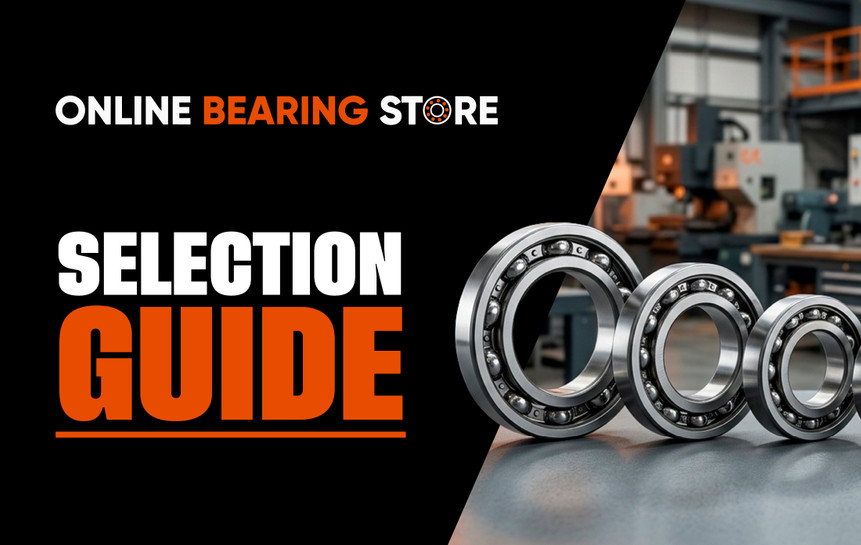
The Complete Selection, Sizing, and Application Guide
Ball bearings are everywhere; from the car you drive to the phone in your hand and the machines that power entire industries. You rely on them every day across many ball bearing applications to reduce friction, support loads, and keep systems running smoothly.
What Are Ball Bearings and How Do They Work?
Basic Operating Principle
Understanding the types of ball bearings starts with how they work. Ball bearings use rolling elements to reduce friction between moving parts. Instead of surfaces sliding, small balls roll between two rings, which lowers heat and wear.
The load travels from the shaft into the inner ring, then through the balls, and finally into the outer ring. This rolling motion supports different ball bearing load rating requirements and allows efficient performance even at high speeds.
Key Components
Each part of a bearing connects directly to performance and durability, especially when working with different ball bearing materials.
- Inner ring attaches to the rotating shaft
- Outer ring fits inside the housing
- Ball elements carry the load while rolling
- Cage or retainer keeps spacing consistent
- Seals and shields protect lubrication
Knowing these parts helps when comparing single row vs double row bearings in real applications.
Radial vs Axial Loads
Load direction is critical when learning how to select ball bearings.
- Radial load acts perpendicular to the shaft
- Axial load acts parallel to the shaft
- Combined load includes both
Different types of ball bearings are designed to handle these loads in specific ways, which directly impacts performance.
What Are the Different Types of Ball Bearings?
Deep Groove Ball Bearings
Deep groove ball bearings are the most common option. They support radial loads and moderate axial loads in both directions.
They are widely used in motors, pumps, and gearboxes. When reviewing ball bearing applications, this type is often the starting point due to its versatility.
Angular Contact Ball Bearings
Angular contact ball bearings are designed for combined loads. Their internal geometry allows them to support axial forces more effectively.
They are available in single and paired configurations, which ties into the discussion of single row vs double row bearings. These are common in machine tool spindles and pumps.
Thrust Ball Bearings
Thrust designs focus on axial loads only. They are useful in systems where force travels along the shaft. When comparing ball bearing vs roller bearing, thrust ball bearings offer a lighter solution for axial loads.
Self-Aligning Ball Bearings
These bearings compensate for misalignment. Their design reduces stress and extends service life.
They are often used in conveyors and heavy-duty systems where alignment is difficult to maintain across different ball bearing applications.
Miniature and Instrument Ball Bearings
Miniature ball bearings are built for precision. Their small size supports tight spaces and delicate systems. You will see them in robotics, drones, and medical devices. Many of these systems also use advanced ceramic ball bearings for better speed and durability.
Bearing Comparison Table
|
Bearing Type |
Load Direction |
Speed Rating |
Typical Applications |
Misalignment Tolerance |
|
Deep Groove |
Radial and moderate axial |
High |
Motors, pumps |
Low |
|
Angular Contact |
Combined |
High |
CNC, spindles |
Low |
|
Thrust |
Axial only |
Medium |
Gear systems |
None |
|
Self Aligning |
Radial |
Medium |
Conveyors |
High |
|
Miniature |
Light loads |
Very high |
Electronics |
Low |
How Do You Select the Right Ball Bearing for Your Application?
Load Type and Magnitude
The first step in how to select ball bearings is understanding load.
You must evaluate:
- Radial and axial forces
- Shock loads
- Required ball bearing load rating
Dynamic and static ratings guide your decision and prevent early failure.
Speed Requirements
Speed limits vary depending on size and lubrication.
Higher speeds often require:
- Precision manufacturing
- Better lubrication
- Proper ball bearing ABEC rating
Choosing the right tolerance improves performance and reduces vibration.
Operating Environment
Environmental conditions strongly influence ball bearing materials selection.
Think about:
- Moisture and corrosion
- Dust and contamination
- Temperature extremes
For harsh environments, stainless steel ball bearings provide corrosion resistance, while sealed designs offer protection.
Precision and Tolerance (ABEC Ratings)
The ball bearing ABEC rating defines precision.
- ABEC 1 for standard use
- ABEC 3 for general industry
- ABEC 5 and above for high precision
Higher ratings are common in aerospace and medical ball bearing applications.
Bearing Series Guide
Bearing series help simplify selection:
- 6000 series for lighter loads
- 6200 series for general use
- 6300 series for heavier loads
Understanding ball bearing sizes and part numbers helps you choose faster and more accurately.
How Do You Size a Ball Bearing Correctly?
Key Dimensional Parameters
Correct sizing ensures performance and reliability.
You must match:
- Bore diameter to shaft
- Outer diameter to housing
- Width to load needs
These ball bearing sizes directly affect strength and lifespan.
ISO Standard Sizing
ISO standards define dimensions across manufacturers. This makes replacement easier and ensures compatibility.
Standard sizing also helps compare types of ball bearings across brands.
Fit and Tolerance
Fit determines how the bearing interacts with surrounding parts.
- Loose fits allow movement
- Tight fits improve stability
Incorrect fits can damage even high-quality ceramic ball bearings or steel designs.
Sizing Reference Table
|
Part Number |
Bore (mm) |
OD (mm) |
Width (mm) |
Dynamic Load C (kN) |
Static Load C0 (kN) |
|
6001 |
12 |
28 |
8 |
5.1 |
2.4 |
|
6201 |
12 |
32 |
10 |
6.8 |
3.1 |
|
6301 |
12 |
37 |
12 |
9.7 |
4.2 |
|
6005 |
25 |
47 |
12 |
11.2 |
5.0 |
|
6205 |
25 |
52 |
15 |
14.0 |
7.8 |
|
6305 |
25 |
62 |
17 |
19.5 |
11.3 |
What Materials Are Ball Bearings Made From?
Chrome Steel (52100)
Chrome steel is widely used due to its strength and durability.
It remains the most common choice among ball bearing materials for industrial applications.
Stainless Steel
Stainless steel ball bearings resist corrosion and perform well in wet environments.
They are ideal for food processing, marine use, and washdown systems.
Ceramic
Ceramic ball bearings offer low weight and high-speed capability.
They also provide:
- Electrical insulation
- Corrosion resistance
- Reduced friction
These benefits make them ideal for advanced systems and high-speed ball bearing applications.
Plastic and Polymer
Polymer materials reduce weight and resist chemicals. They are often used alongside steel or ceramic components in specialized designs.
What Are the Sealing and Shielding Options for Ball Bearings?
Open Bearings
Open bearings allow direct lubrication.
They are best used in clean environments where maintenance is frequent and controlled.
Shielded Bearings (ZZ)
Shielded designs block debris while allowing higher speeds. They are a common choice when balancing protection and performance in many types of ball bearings.
Sealed Bearings (2RS)
Sealed bearings keep grease inside and contaminants out.
They are widely used in outdoor and industrial ball bearing applications where reliability is critical.
Seal Comparison Table
|
Seal Type |
Contamination Protection |
Speed Limitation |
Re Lubrication Required |
Typical Use Cases |
|
Open |
None |
Very high |
Yes |
Clean systems |
|
Shielded |
Moderate |
High |
Limited |
Motors |
|
Sealed |
High |
Medium |
No |
Outdoor, wet |
Where Are Ball Bearings Used?
Industrial Machinery
Machines rely on bearings for smooth operation. Motors, conveyors, and compressors all depend on correct ball bearing sizes and load ratings.
Automotive
Automotive systems use bearings in wheels, engines, and transmissions.
Understanding ball bearing vs roller bearing helps engineers choose the right design for each component.
Aerospace and Defense
These industries require precision and durability.
High grade ceramic ball bearings and advanced tolerance levels ensure performance under extreme conditions.
Medical and Laboratory
Medical tools require quiet and precise motion.
Miniature ball bearings and corrosion resistant materials are essential in these environments.
Consumer Electronics and Robotics
Small devices depend on compact solutions.
These systems often use specialized types of ball bearings designed for speed and accuracy.
How Do Ball Bearings Compare to Other Bearing Types?
Ball vs Roller Bearings
The key difference in ball bearing vs roller bearing comes down to contact type.
- Ball bearings use point contact for speed
- Roller bearings use line contact for higher loads
Each has its place depending on the application.
Ball vs Plain or Sleeve Bearings
Plain bearings rely on sliding contact.
Ball bearings reduce friction and improve efficiency, especially in high-speed systems and modern ball bearing applications.
Comparison Table
|
Bearing Type |
Load Capacity |
Speed |
Friction |
Cost |
Best For |
|
Ball |
Medium |
High |
Low |
Moderate |
General use |
|
Roller |
High |
Medium |
Medium |
Higher |
Heavy loads |
|
Plain |
Low to medium |
Low |
High |
Low |
Simple systems |
What Ball Bearings Does Online Bearing Store Stock?
Product Range Overview
Online Bearing Store offers a wide range of products for those looking to buy ball bearings online.
Available options include:
- Deep groove
- Angular contact
- Thrust
- Self-aligning
- Miniature
- Stainless steel
- Ceramic hybrid
This variety ensures coverage for nearly all ball bearing applications.
Leading Brands Stocked
You can find trusted manufacturers such as:
- SKF
- NSK
- FAG
- Timken
- NTN
- Koyo
- INA
Expert Bearing Selection Support
If you need help with how to select ball bearings, expert support is available.
You can get assistance with:
- Cross referencing
- Application matching
- Bulk orders
Find the Right Ball Bearing for Your Application
Browse the full selection and compare specifications to match your needs. When you are ready to buy ball bearings online, reach out to the Online Bearing Store team for expert guidance and fast support.
FAQ
1. What are ball bearings used for?
You use ball bearings to reduce friction and support loads in machines like motors, pumps, and wheels.
2. How do I choose the right ball bearing?
You need to consider load, speed, environment, and ball bearing materials.
3. What is the difference between sealed and shielded bearings?
Sealed bearings fully block contaminants, while shielded bearings provide partial protection.
4. What size ball bearing do I need?
You must match the shaft and housing dimensions using correct ball bearing sizes.
5. What is a good ABEC rating?
A suitable ball bearing ABEC rating depends on your application, but ABEC 3 works for most uses.
6. Are ceramic ball bearings better?
Ceramic ball bearings perform better at high speeds and resist corrosion but cost more.
7. How long do ball bearings last?
Life depends on load, lubrication, and operating conditions.
8. Can ball bearings handle axial loads?
Yes, certain types of ball bearings like angular contact and thrust designs handle axial loads.
9. What causes bearing failure?
Common causes include contamination, poor lubrication, and incorrect ball bearing load rating selection.
10. Where can I buy ball bearings online?
You can buy ball bearings online from trusted suppliers like Online Bearing Store for quality and fast delivery.